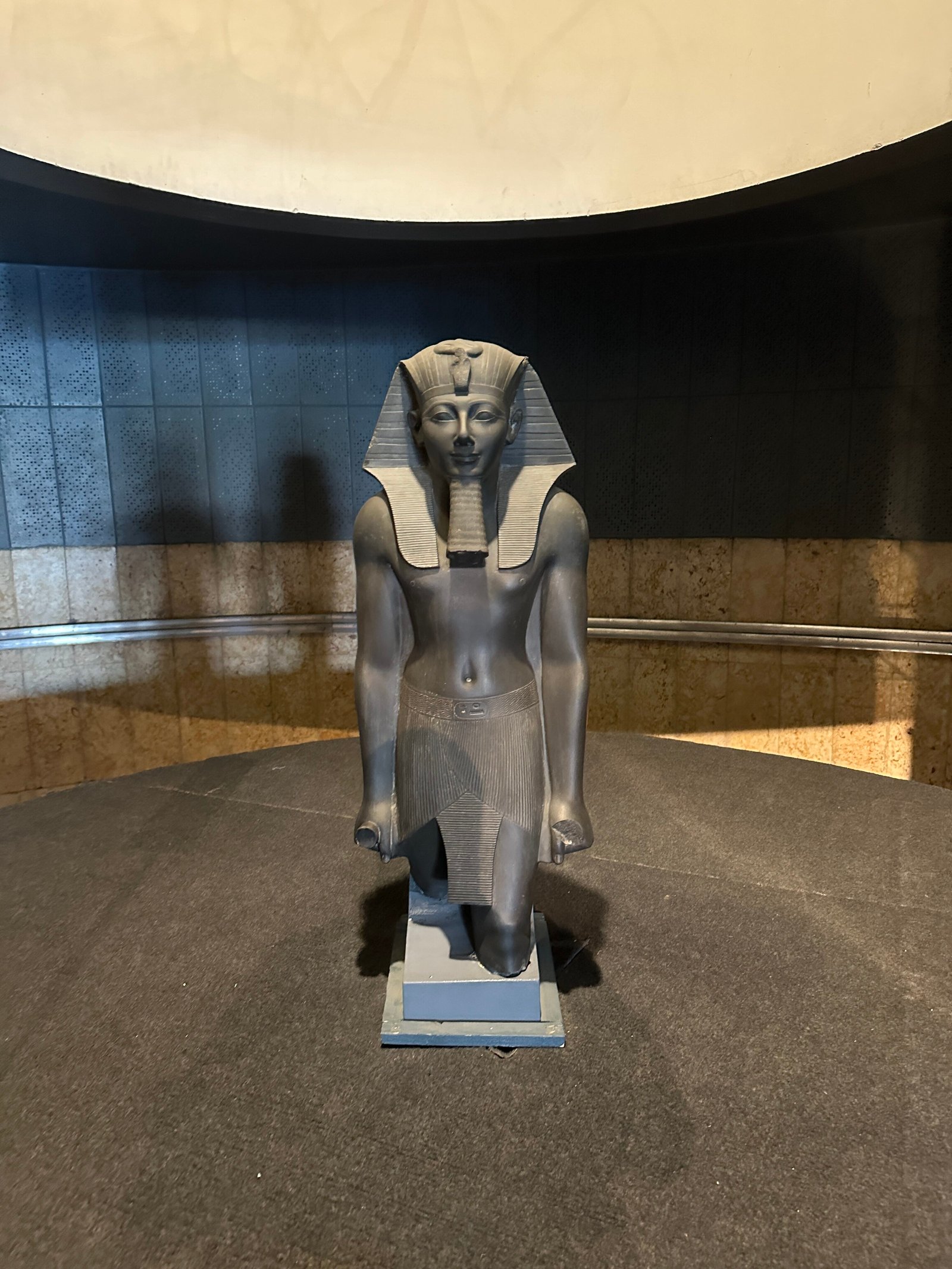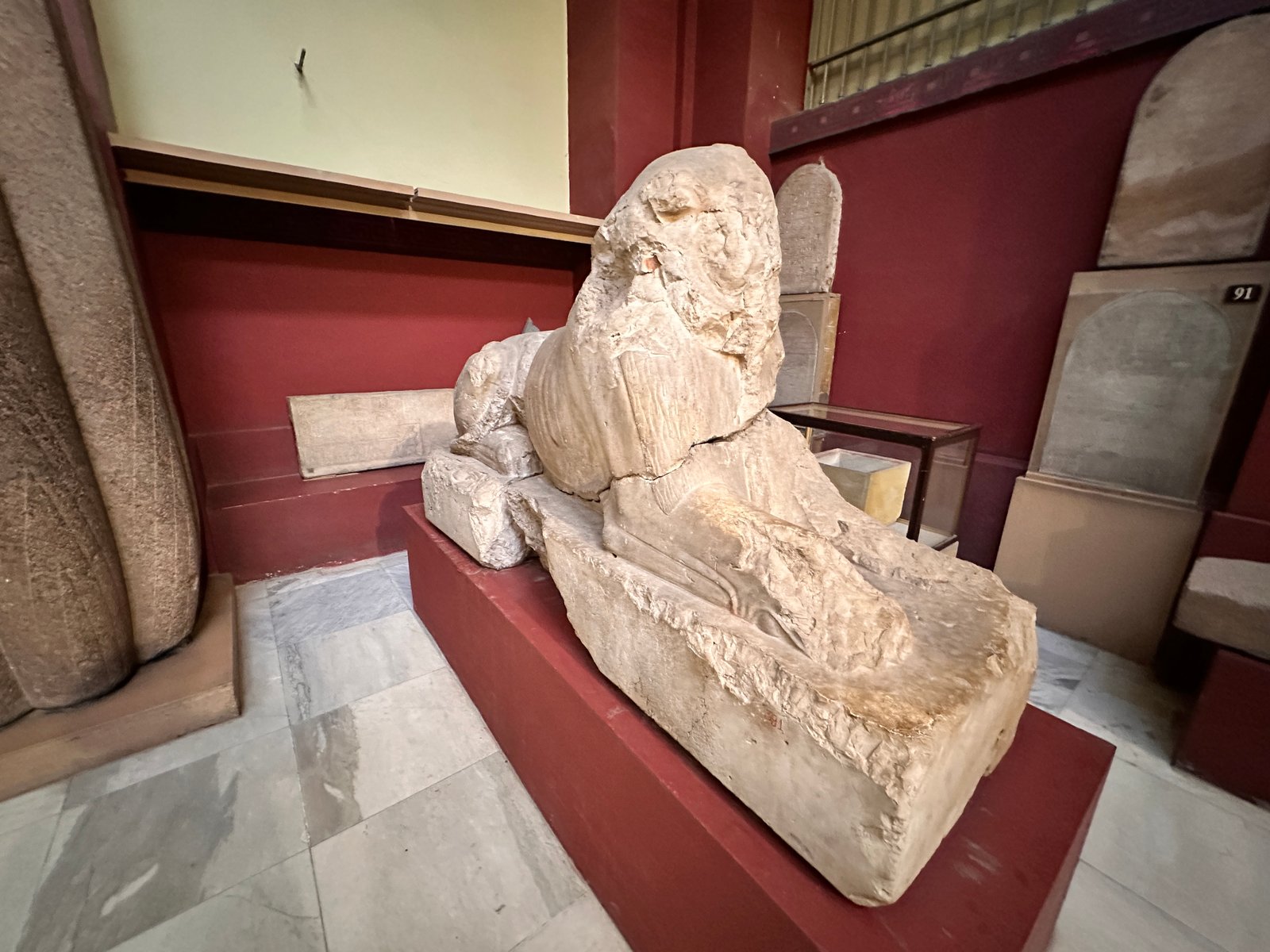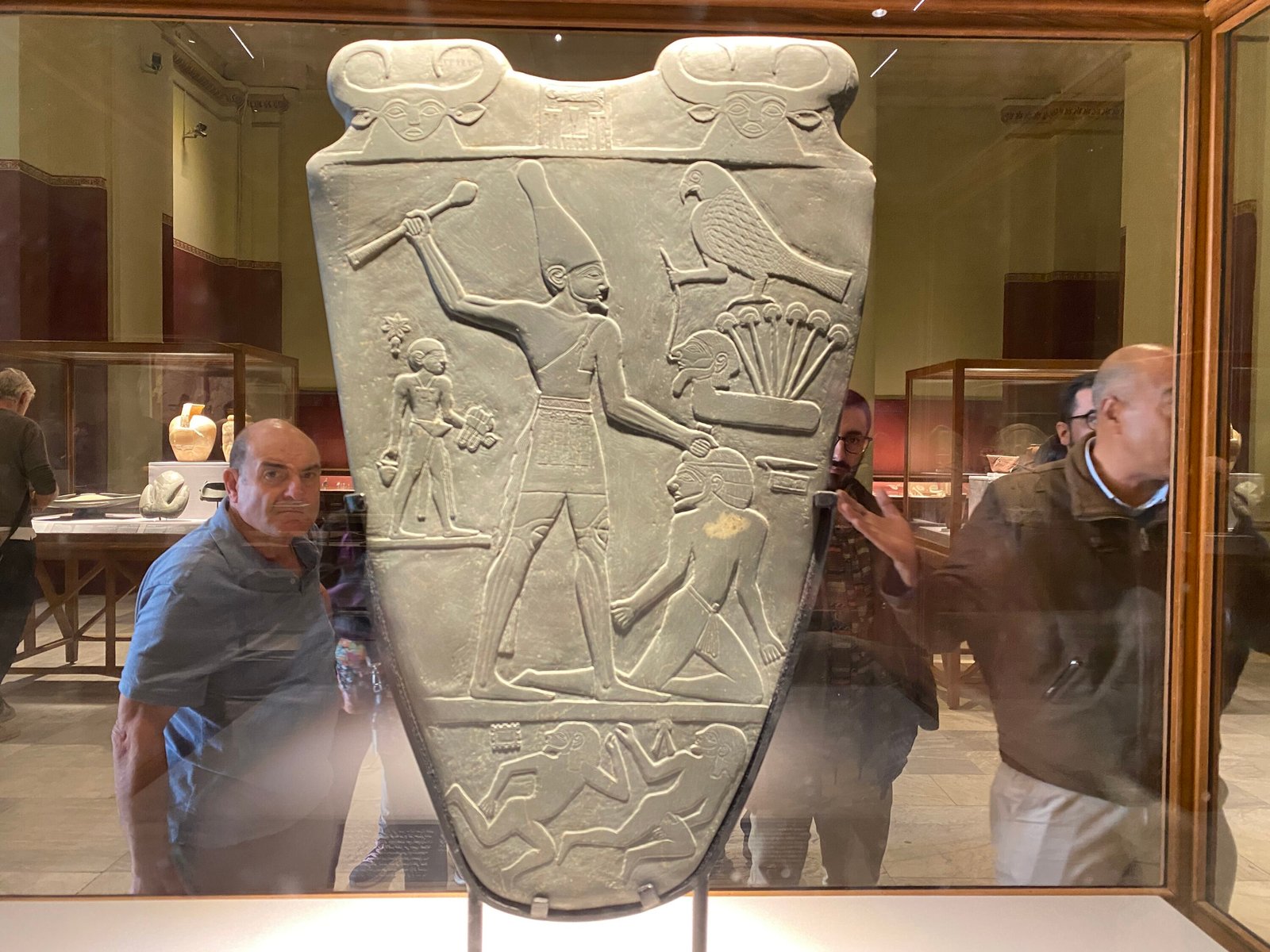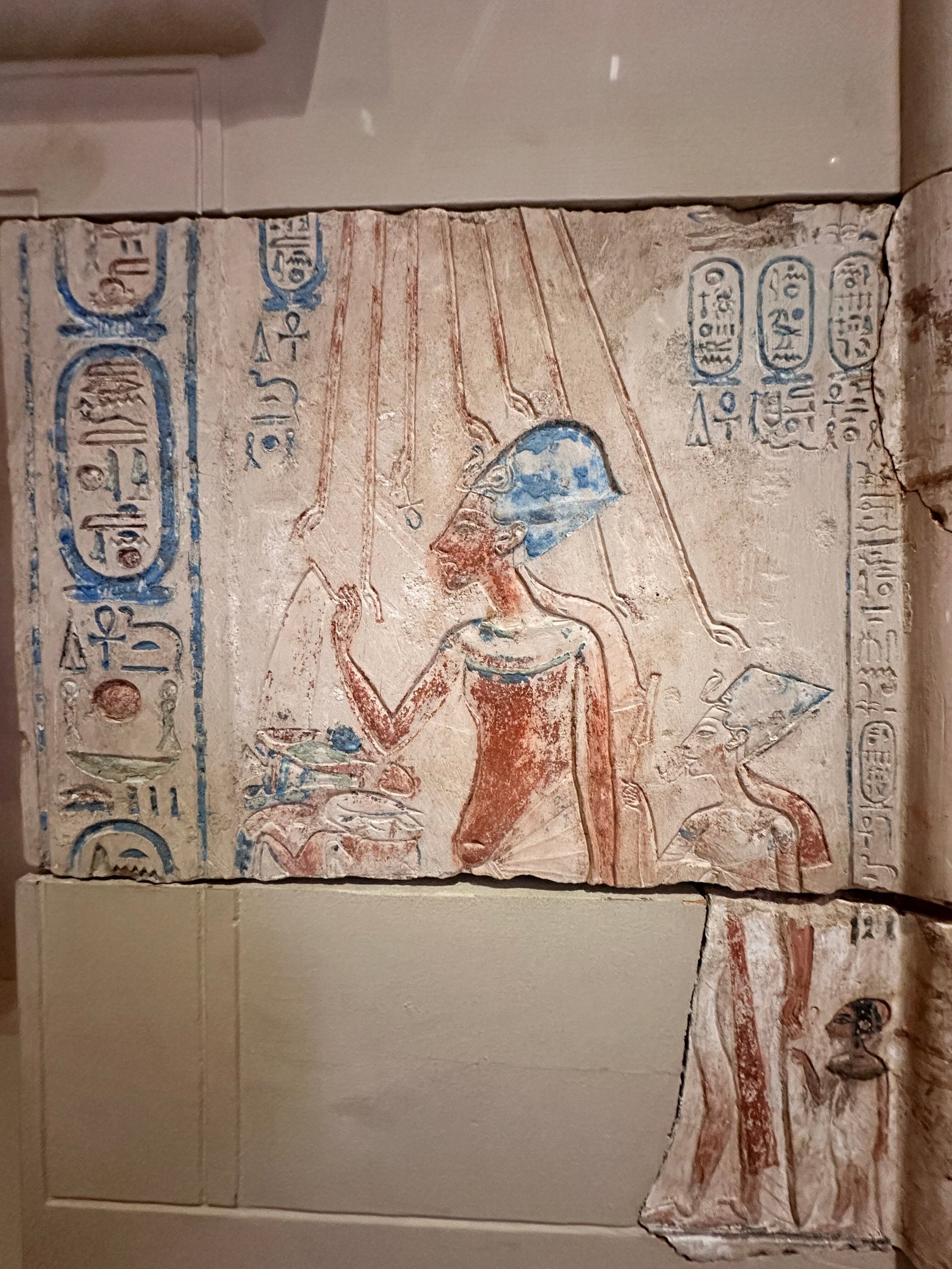
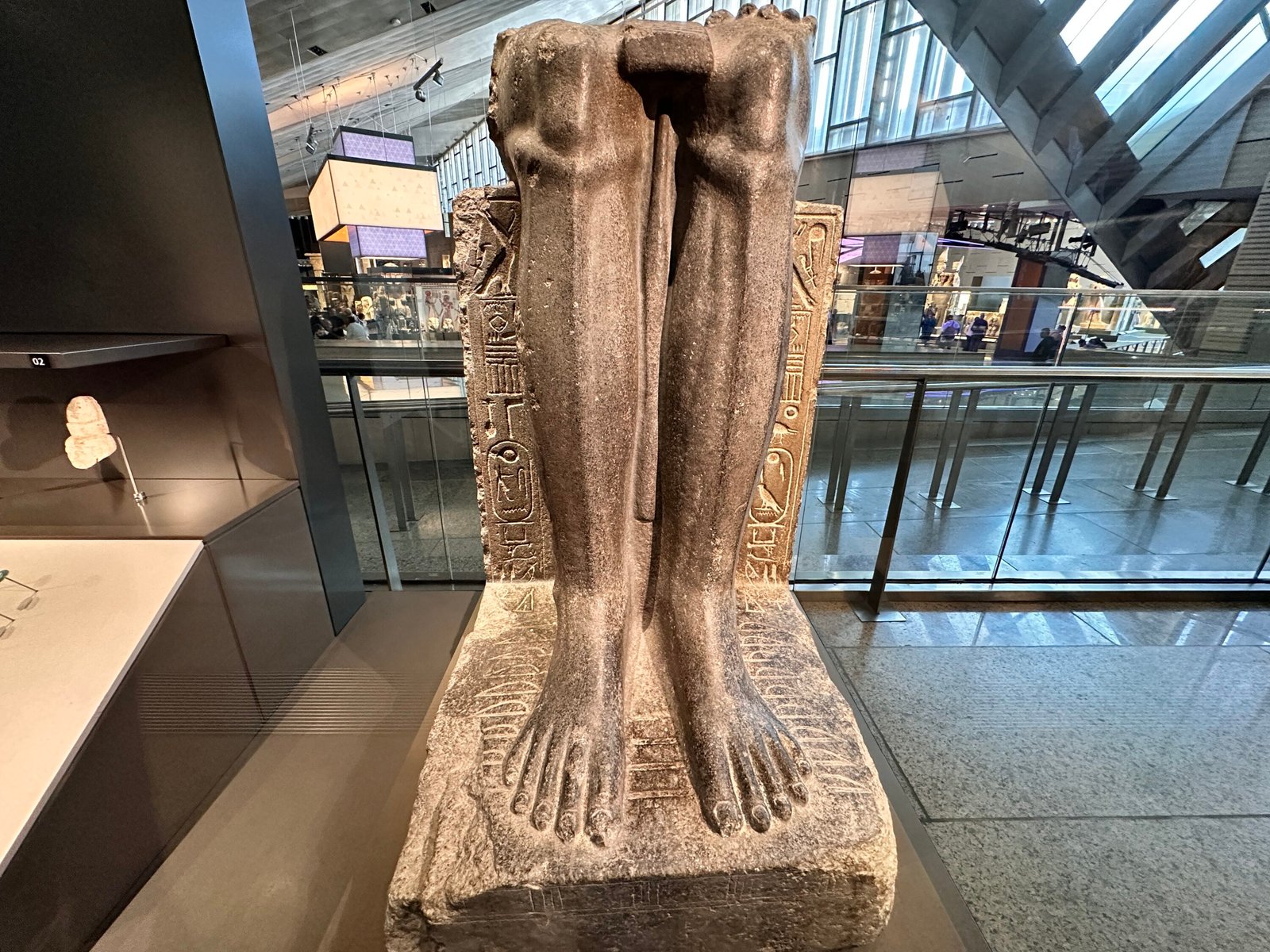
Statue of Hyksos Ruler Khyan from Bubastis — CG 389 / JE 28574
The surviving lower portion of this grey-granite royal statue preserves the names of Khyan, one of the most important rulers of Egypt’s 15th Dynasty Hyksos. The monument was discovered by Édouard Naville in 1887 in the great temple at Bubastis, modern Tell Basta, and was historically cataloged as CG 389 / JE 28574. It is now displayed at the Grand Egyptian Museum in Giza.
Key Facts
- Object: Surviving lower portion of a royal statue reinscribed for Khyan.
- Ruler: Khyan (Khayan / Khian).
- Period: Second Intermediate Period; generally placed at the beginning of the 15th Dynasty, though some chronological schemes place him on the late 14th / early 15th-Dynasty horizon.
- Historical catalog numbers: CG 389 / JE 28574.
- Material: Grey granite.
- Findspot: Great temple at Bubastis, modern Tell Basta.
- Excavator: Édouard Naville, 1887.
- Current display: Grand Egyptian Museum, Giza.
- Royal names preserved: Khyan’s throne name Seuserenra and personal name Khyan, with additional royal titulary.
The Surviving Statue
Only the lower portion of the statue survives. The fragment preserves the ruler’s legs and substantial hieroglyphic inscriptions along the sides. The monument is one of the most important sculptural attestations of Khyan because his royal names are preserved directly on the stone.
Khyan’s Royal Titulary
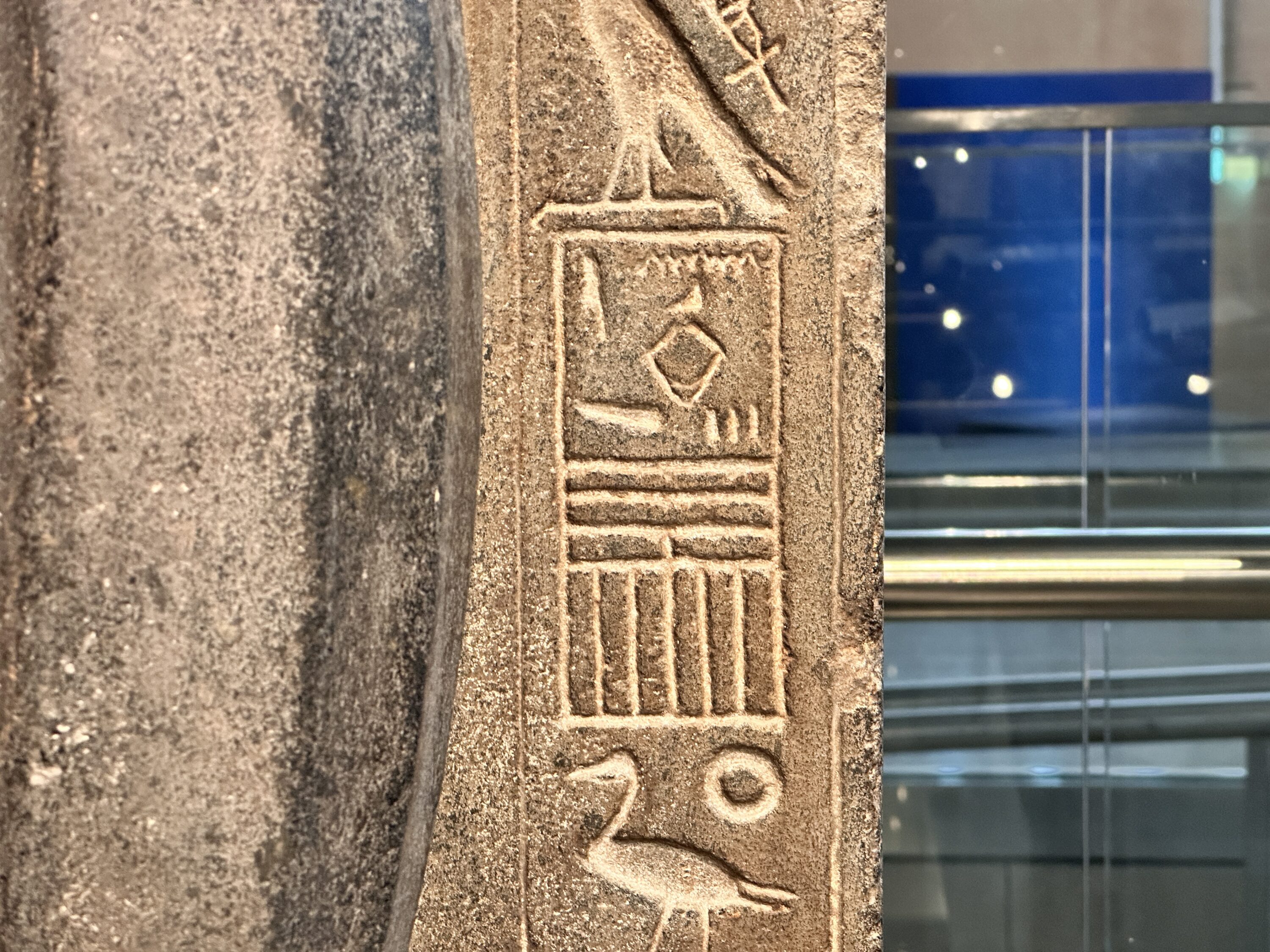
The inscriptions preserve Khyan’s Egyptian royal titulary. His throne name is conventionally read Seuserenra (s-wsr.n-Rꜥ), while his personal name is Khyan (ḫyꜣn). Other attestations also give him the title Heqa-khasut, “ruler of foreign lands,” the Egyptian expression from which the term Hyksos ultimately derives.
The Royal Cartouche
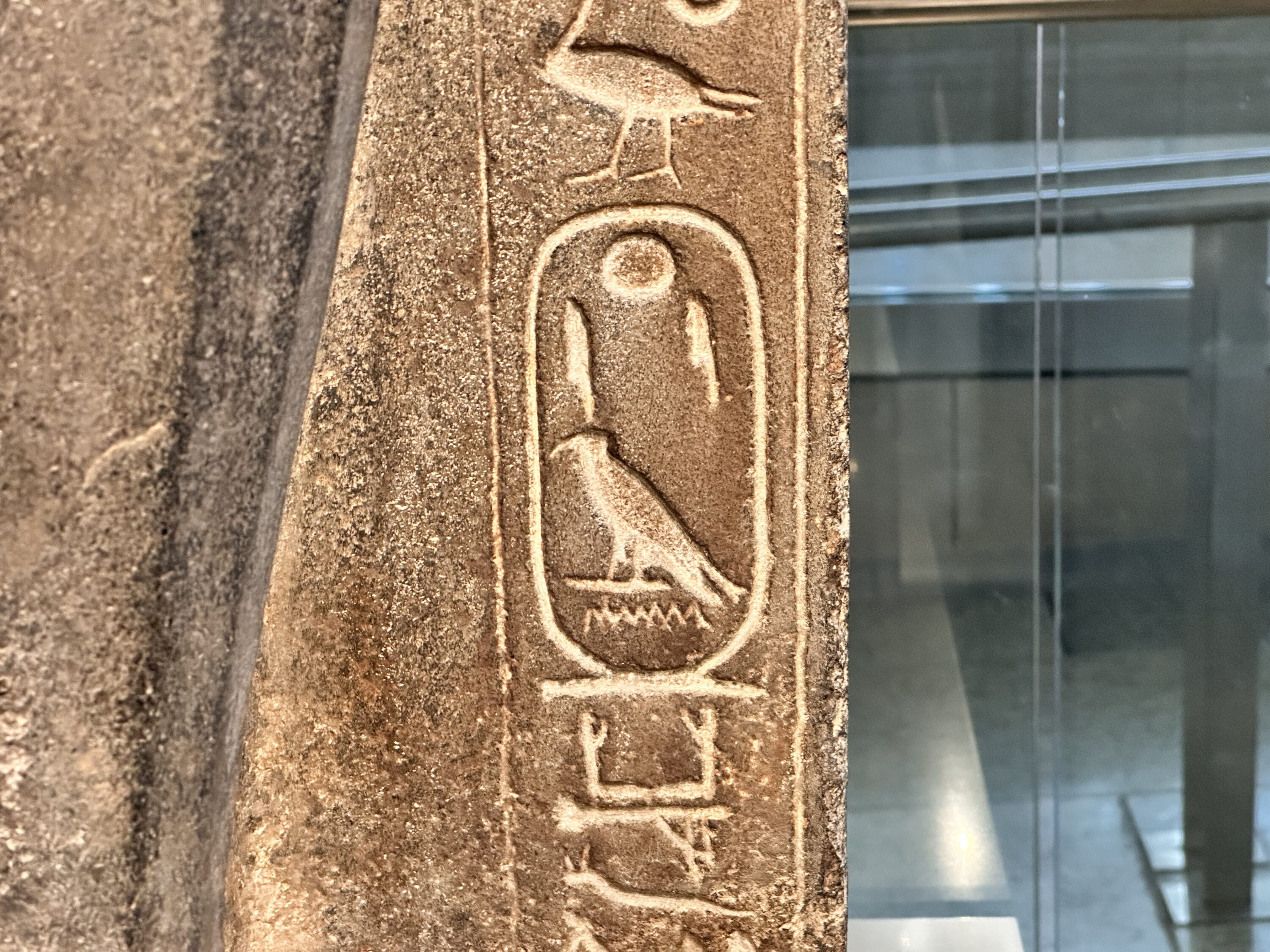
A second close view isolates one of the royal cartouches carved into the statue. These inscriptions are central to the identification of the monument because they connect the surviving sculpture directly with Khyan rather than relying only on stylistic comparison.
An Earlier Statue Reused by a Hyksos Ruler
Khyan appears to have reappropriated an earlier Middle Kingdom royal statue. His names were carved over earlier erased inscriptions. Older scholarship commonly identified the underlying sculpture as 12th Dynasty, while more recent treatments continue to recognize the monument as an earlier royal statue usurped by Khyan.
The secure point is that Khyan’s inscriptions were added over an earlier erased royal text. The fragment therefore records both an older Egyptian royal monument and its later appropriation under Hyksos rule.
Khyan and the Early Hyksos Period
Khyan was one of the best-attested rulers associated with the rise of Hyksos power in the eastern Nile Delta. His exact chronological position remains debated. Older reconstructions often placed him in the middle of the 15th Dynasty, but more recent archaeological work has pushed him considerably earlier, toward the beginning of the 15th Dynasty and, in some schemes, close to the transition from the 14th Dynasty. Objects bearing his name have been found well beyond the Delta, including Upper Egypt and the wider eastern Mediterranean and Near East.
Khyan also belongs close in time to Yaqub-Har, a Semitic-named ruler whose placement between the late 14th and early 15th Dynasty is likewise debated. Some reconstructions place Yaqub-Har before Khyan, making Khyan a possible successor, while other scholars reverse or otherwise rearrange their relationship. The close stylistic relationship between their scarabs nevertheless points to chronological proximity. Yaqub-Har’s name is often discussed alongside the West Semitic Jacob / Yaqub name family, although the historical identification of Yaqub-Har with the biblical Jacob is a separate and debated question.
Within the historical framework used by Egypt Christian Tours, the Hyksos were rooted primarily in the biblical Hebrew population that had grown in the eastern Nile Delta, later becoming a more mixed Semitic and Levantine population. Khyan therefore belongs not to a late phase of Hyksos power, but to the formative or early phase of that political development, before the later rulers Apepi and Khamudi and long before the final defeat of Hyksos rule under Ahmose I.
Bubastis and the Eastern Delta
The statue was found at Bubastis, not Tanis. Bubastis lies in the eastern Nile Delta and occupied a strategic position within the wider landscape connecting the Delta with Wadi Tumilat, Avaris, Sinai, and Canaan. Khyan’s monument therefore belongs geographically as well as historically within the broader eastern-Delta world of Hyksos rule.
Research Sources and Further Reading
- Naville, Édouard. Bubastis (1887–1889). Egypt Exploration Fund Memoir 8. London, 1891. Historical photograph and object identification.
- Leprohon, Ronald J. The Great Name: Ancient Egyptian Royal Titulary. Atlanta: Society of Biblical Literature, 2013. Khyan’s royal names.
- Forstner-Müller, Irene, and Nadine Moeller, eds. The Hyksos Ruler Khyan and the Early Second Intermediate Period in Egypt. Open-access volume.
- Connor, Simon. Être et paraître: Statues royales et privées de la fin du Moyen Empire et de la Deuxième Période intermédiaire (1850–1550 av. J.-C.). Discussion of Cairo CG 389 and the statue from Bubastis.
Full-Size Images
Click a thumbnail to open the full-size photograph in a new tab. See the Egypt Photo Gallery for image-use and licensing terms.
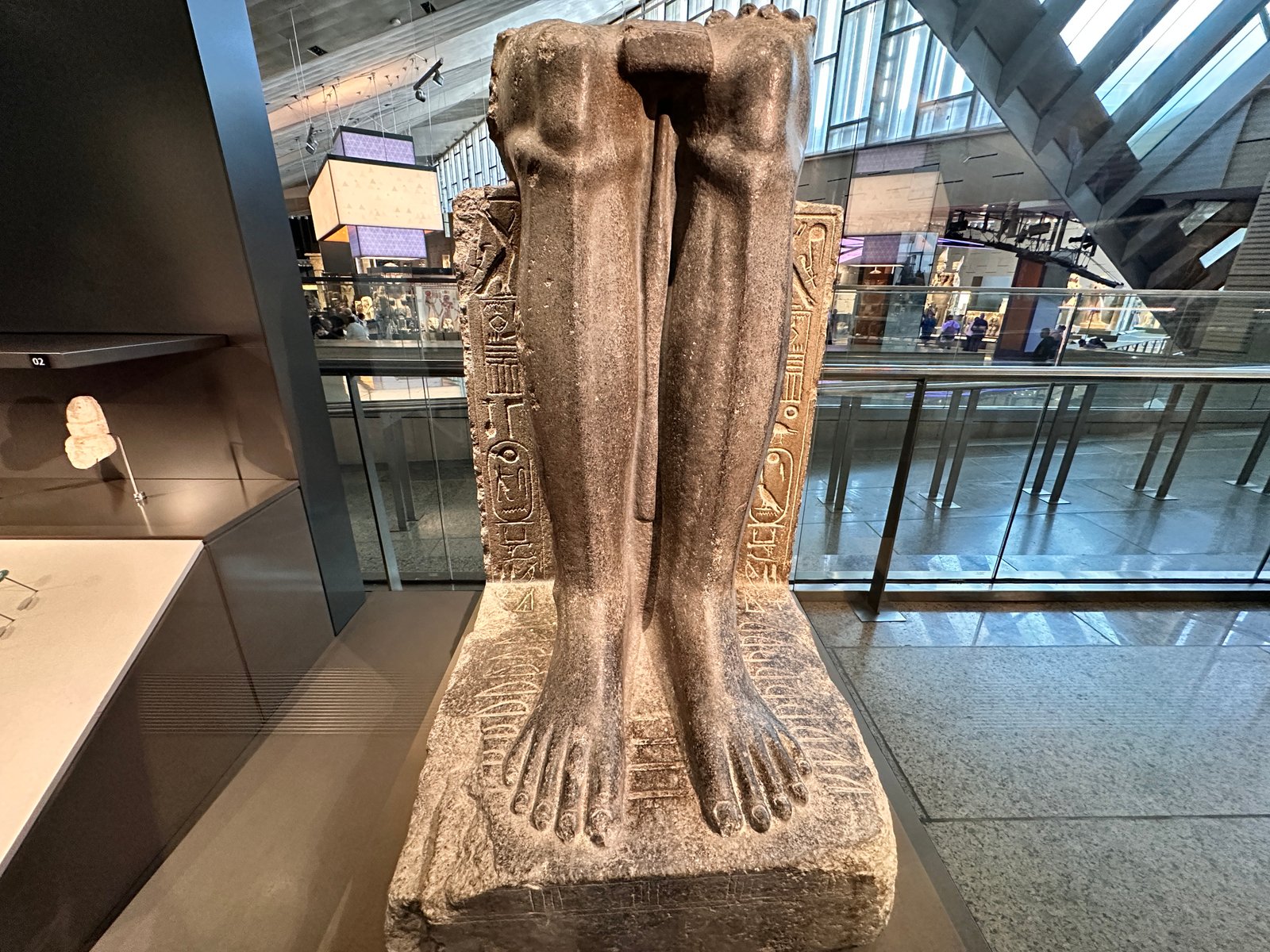
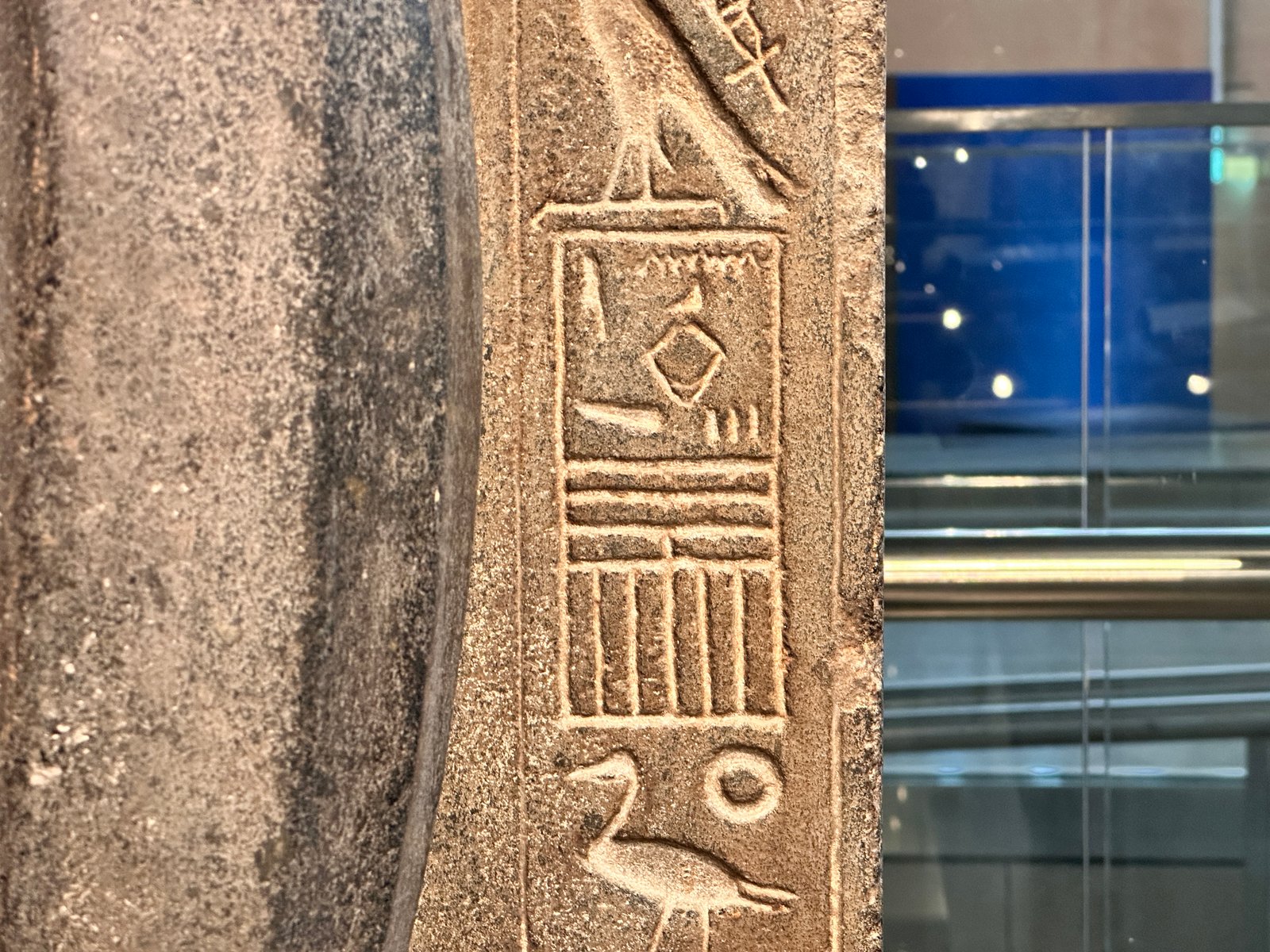
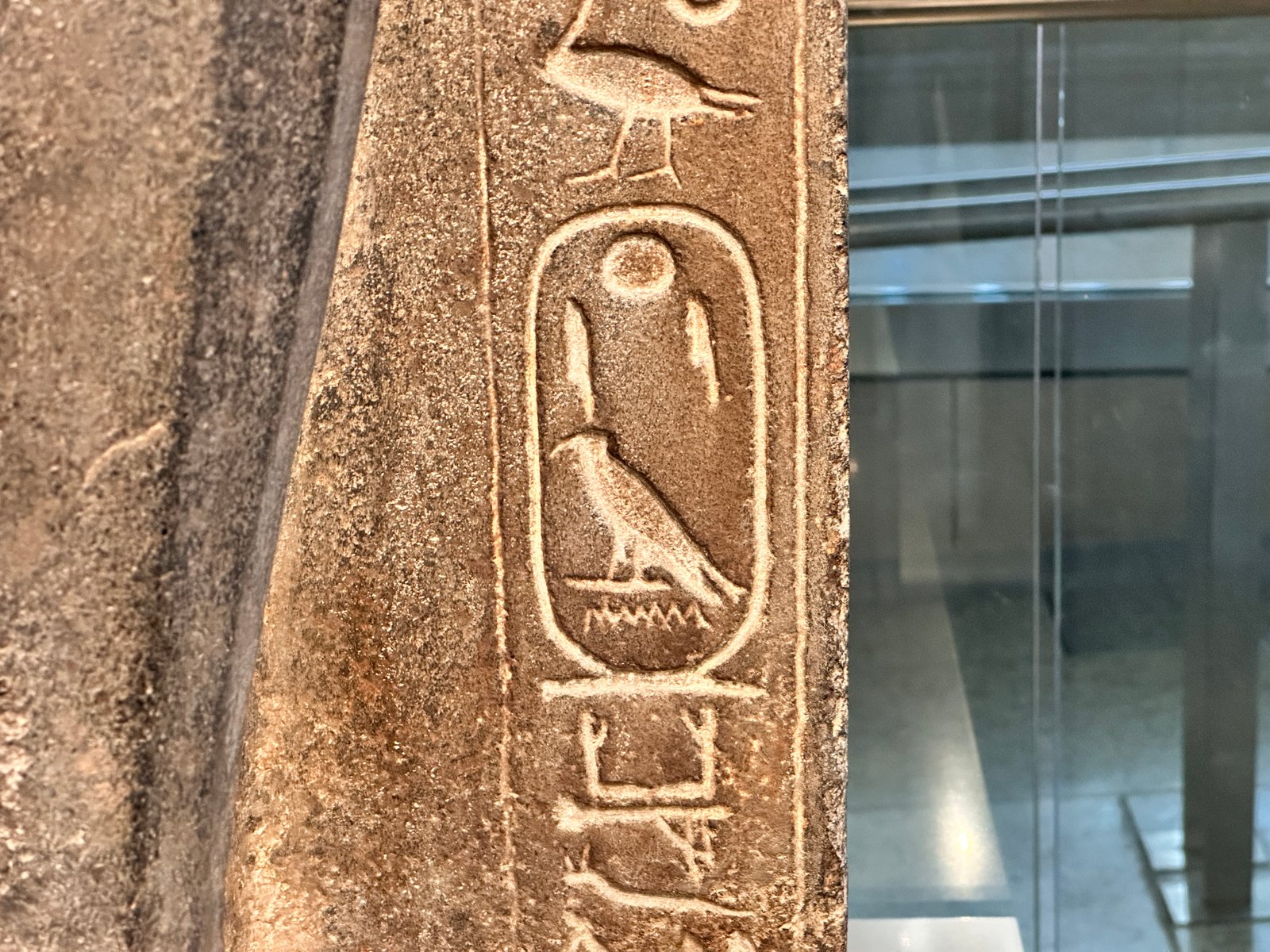
Image licensing: Original Egypt Christian Tours photography is available under the licensing terms stated in the Egypt Photo Gallery.