Narmer Palette JE 32169: Kingship, Victory, and Early Egypt
The Narmer Palette, JE 32169, is one of the most important surviving monuments from the emergence of the early Egyptian state. Found at Hierakonpolis, the ceremonial palette combines royal names, crowns, defeated enemies, divine imagery, processions, mythical animals, and some of the earliest developed conventions of Egyptian royal art.
Key Facts
- Object: Narmer Palette / Great Hierakonpolis Palette.
- King: Narmer.
- Period: Early Dynastic Period, associated with the beginning of the 1st Dynasty.
- Findspot: Temple district at Hierakonpolis, near the so-called Main Deposit.
- Inventory number: Egyptian Museum JE 32169; formerly cataloged as CG 14716.
- Material: Siltstone/greywacke. Older literature often called the stone “slate.”
- Dimensions: About 63.5 cm high and 42 cm wide in the Narmer Catalog.
- Current collection: Egyptian Museum, Cairo.
- Interpretive caution: The palette is central to discussions of political unification, but the scenes are royal ideological imagery and should not automatically be read as a literal narrative of one historical battle.
Object Identity and Archaeological Context
The Global Egyptian Museum record for JE 32169 identifies the palette with King Narmer and describes the major scenes on both faces. The Narmer Catalog, entry 0081, provides a particularly useful object-level record: Hierakonpolis, Dynasty 1, Narmer, Egyptian Museum Cairo, JE 32169 (formerly CG 14716), and a stone material more accurately described as greywacke/siltstone rather than slate.
The palette’s scale and elaborate relief distinguish it from an ordinary utilitarian cosmetic palette. UCLA’s Encyclopedia of Egyptology discussion of ceremonial palettes likewise treats the Narmer Palette as the quintessential example of this late ceremonial tradition.
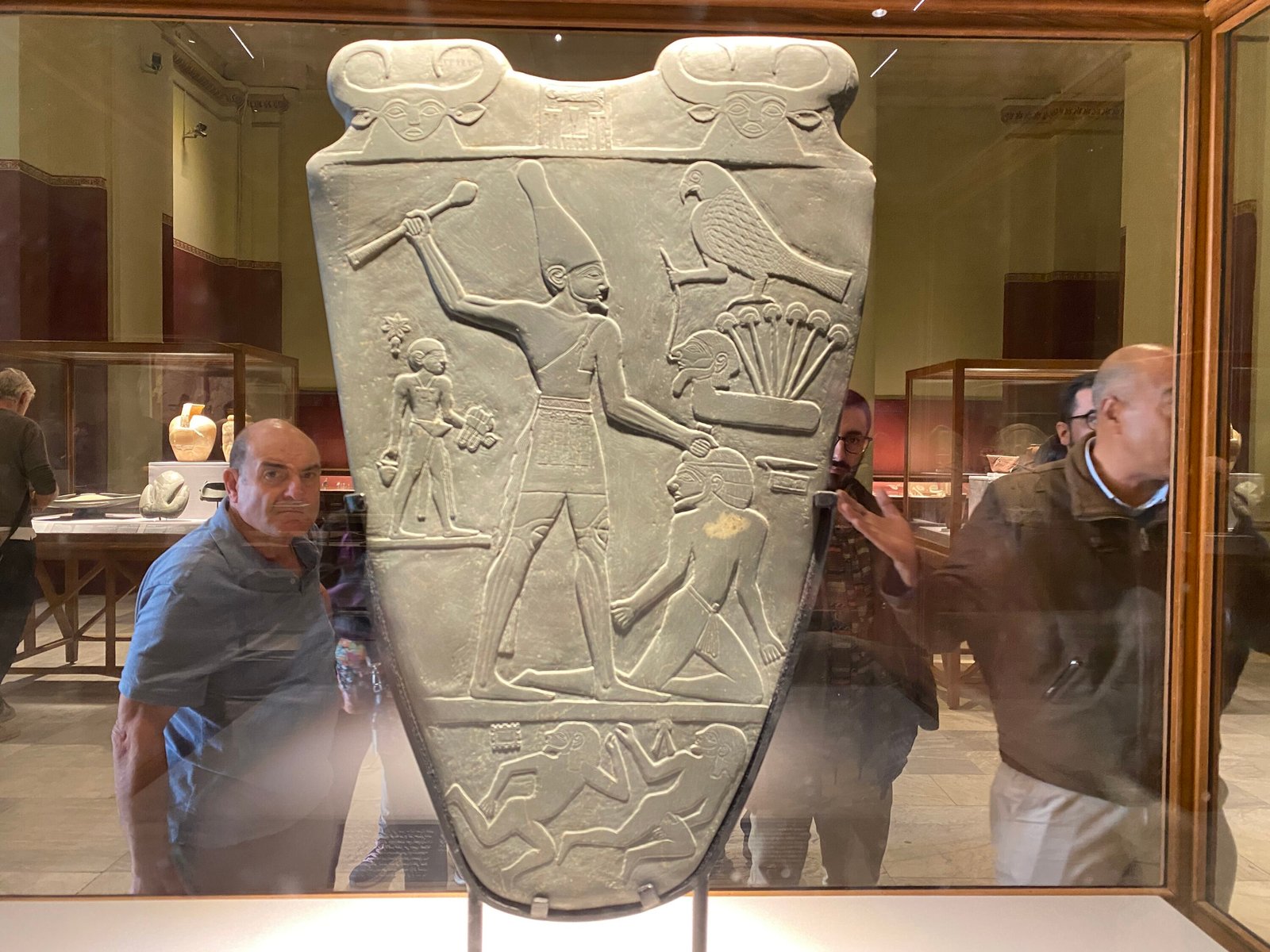
Narmer Smiting an Enemy
One face shows Narmer wearing the White Crown of Upper Egypt, raising a mace over a kneeling enemy. Behind the king stands his sandal bearer. Before him, the falcon god Horus is associated with a papyrus-marsh motif and a subdued figure.
The smiting pose would become one of the most durable images of Egyptian kingship: the ruler shown at overwhelming scale defeating an enemy and restoring or enforcing order. It is therefore both historical evidence and political theology expressed visually.
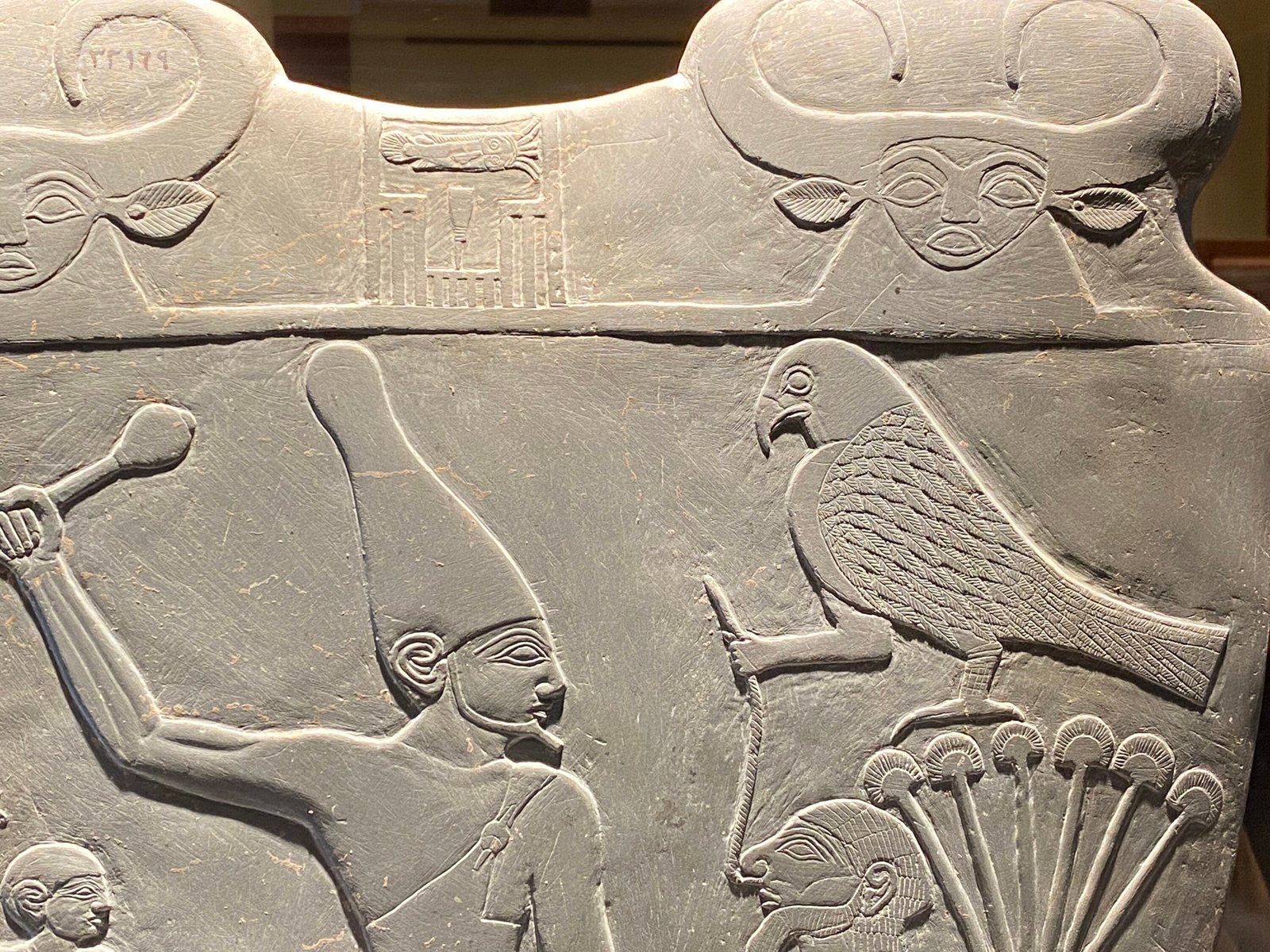
Horus and the Papyrus Marsh
A close detail shows Horus above papyrus plants beside the smiting scene. The Global Egyptian Museum interprets the papyrus imagery and captive in connection with the north. Whatever the precise historical event behind the composition, Horus clearly participates in the visual claim that the king’s victory is divinely sanctioned.
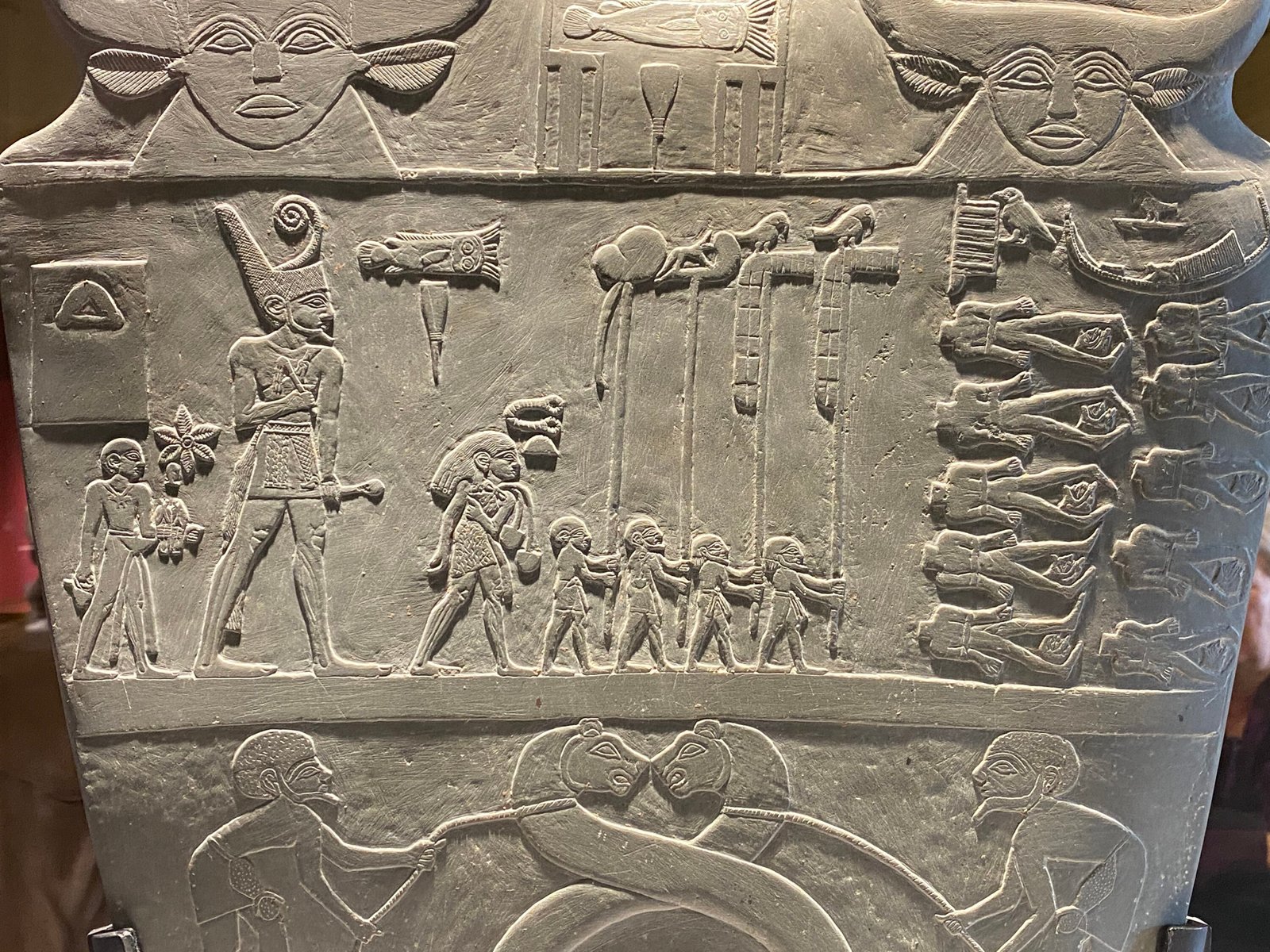
The Red Crown and Victory Procession
On the opposite face Narmer wears the Red Crown of Lower Egypt. He proceeds with attendants and standard bearers toward rows of decapitated enemies. The appearance of the same king with the two regional crowns is one reason the palette became so important in discussions of the consolidation of Upper and Lower Egypt.
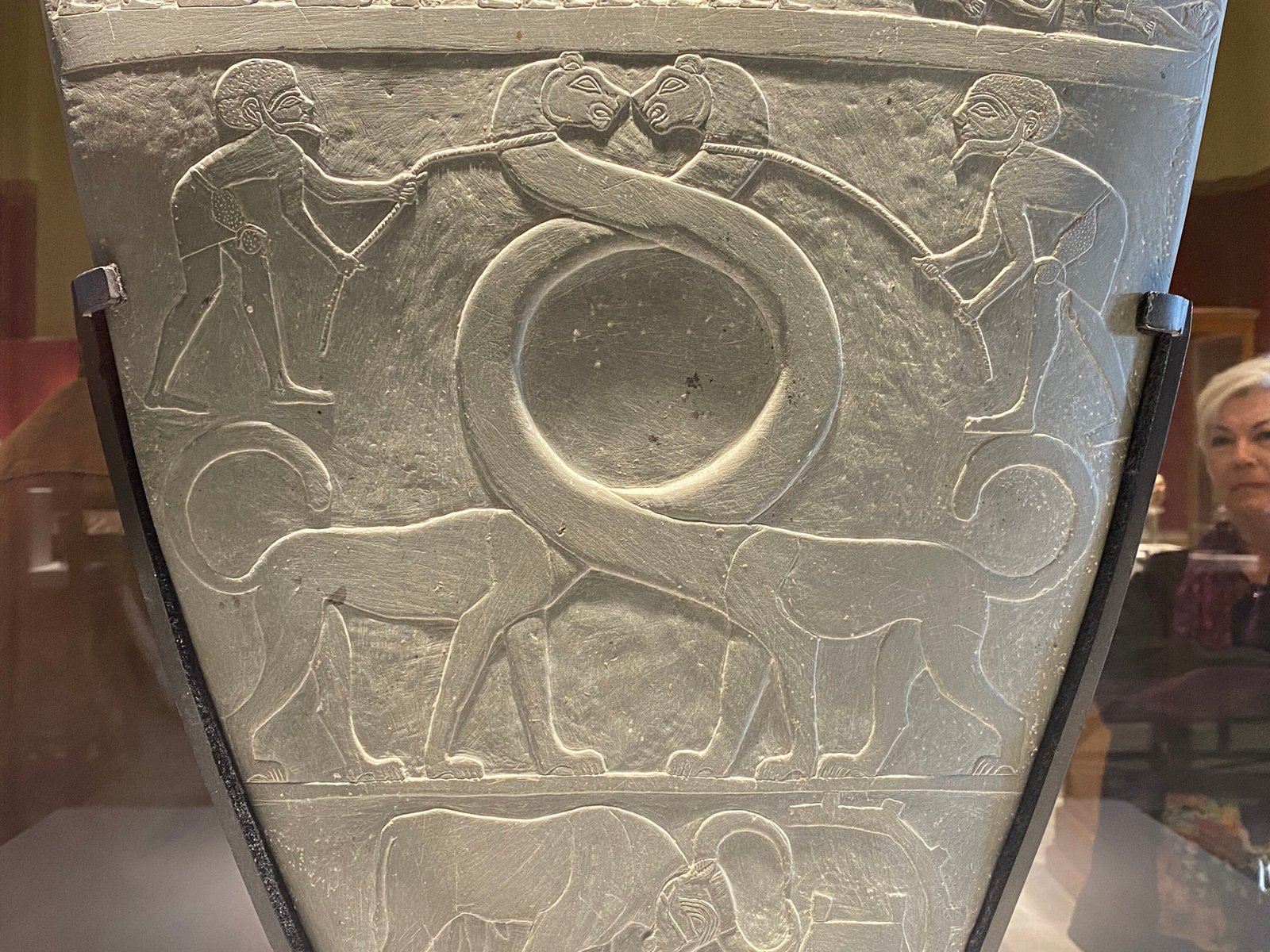
The Intertwined Serpopards
The middle register contains two long-necked mythical animals, commonly called serpopards, whose necks curve around the circular recess of the palette while handlers restrain them. Their meaning remains debated. They have often been interpreted as symbols of forces being brought under control or even as an image of political union, but that symbolism is interpretive rather than an inscribed explanation supplied by the object itself.
Narmer’s Name and Early Royal Writing
Both faces are topped by the king’s name inside a serekh. The catfish and chisel signs form the name conventionally read as Narmer. This combination of image, royal title, register composition, and hieroglyphic labeling makes the palette a particularly important document for the development of Egyptian kingship and visual communication.
Does the Palette Record the Unification of Egypt?
The palette has long been presented as a record of the unification of Upper and Lower Egypt under Narmer. That remains an important interpretation, and the Global Egyptian Museum explicitly frames the scenes in relation to political unification. Modern scholarship, however, also emphasizes that ceremonial royal images are highly constructed ideological compositions. The safer formulation is that JE 32169 is foundational evidence for the ideology and political consolidation associated with early Egyptian kingship; whether every register describes one literal campaign is a separate historical question.
Why It Matters for Biblical-Egypt Background
The Narmer Palette predates the periods in which most proposed biblical-Egypt correlations are discussed. Its relevance is therefore not a direct biblical identification. Instead, it documents the deep roots of institutions that later characterize pharaonic Egypt: sacred kingship, royal titulary, divine sanction, domination of foreign or rebellious enemies, formal processions, standards, and the visual language of political order.
See the Egypt Museum Artifact Index for additional identified objects and the Biblical Egypt Research Index for broader archaeological resources.
Research Sources and Further Reading
- Global Egyptian Museum. “Narmer Palette, JE 32169.” Object record.
- Narmer Catalog. “Catalog No. 0081: Narmer Palette.” Catalog PDF.
- Stevenson, Alice. “Palettes.” In UCLA Encyclopedia of Egyptology, edited by Willeke Wendrich. Los Angeles: UCLA, 2009. Open-access article.