

Seeing the World of the Bible Through Egypt’s Greatest Museum
The Grand Egyptian Museum is not simply one enormous gallery. It is better understood as a museum complex made up of several major experiences, each with its own purpose and character. For a first-time visitor, it can almost feel like four museums in one: the monumental Grand Stairs, the chronological Main Galleries, the self-contained Tutankhamun Galleries, and the separate Khufu’s Boats Museum.
That layout is especially useful for Christian travelers and students of biblical archaeology. Instead of trying to “find the Bible” in every object, the museum allows you to move through the political, religious, technological, and social worlds that form the historical background of Genesis, Exodus, and the later history of Israel.
The GEM complex covers roughly 500,000 square meters and is the world’s largest museum complex devoted to a single civilization.
Twelve principal halls span Egyptian history from prehistory through the Roman period and can be followed chronologically or thematically.
The permanent galleries repeatedly organize the collection around Kingship, Society, and Beliefs, three themes especially useful for understanding the biblical world.
Think of GEM as Four Museums in One
The Grand Stairs
The Grand Stairs are not merely the route to the upper galleries. They function as a monumental exhibition in their own right, using large royal statues, architectural elements, sarcophagi, and sacred imagery to introduce royal power, temples, kings and the Egyptian gods, and funerary beliefs.
For biblical archaeology, this is an excellent place to begin because it establishes what “Pharaoh” meant in Egyptian culture. Among the objects to watch for are Middle Kingdom royal monuments, including the granite sphinx of Amenemhat III, as well as New Kingdom royal and funerary material.
The Main Galleries
The Main Galleries are the heart of the museum’s broad historical story. Twelve halls carry visitors from prehistoric Egypt through the Roman period while repeatedly examining kingship, society, and religious belief.
This is where a biblical-archaeology visitor should spend the most deliberate time. Middle Kingdom and Second Intermediate Period displays provide the strongest context for Joseph, the eastern Delta, Asiatic populations, Avaris, the Hyksos period, and the transition toward the New Kingdom. Later galleries provide the political and material setting for the 18th Dynasty and our preferred Exodus chronology.
The Tutankhamun Galleries
The Tutankhamun collection is so extensive that it effectively functions as a museum within the museum. Rather than mixing the king’s objects throughout the broader galleries, the GEM presents his tomb material as a distinct experience built around discovery, identity, royal life, burial, and the afterlife.
Tutankhamun lived later than our preferred date for the Exodus, so his objects should not be treated as direct evidence for Moses. They are nevertheless extraordinarily useful for understanding 18th-Dynasty royal life, chariots, weapons, furniture, clothing, foreign captives, religious imagery, and funerary practice within the same broad New Kingdom world.
Khufu’s Boats Museum
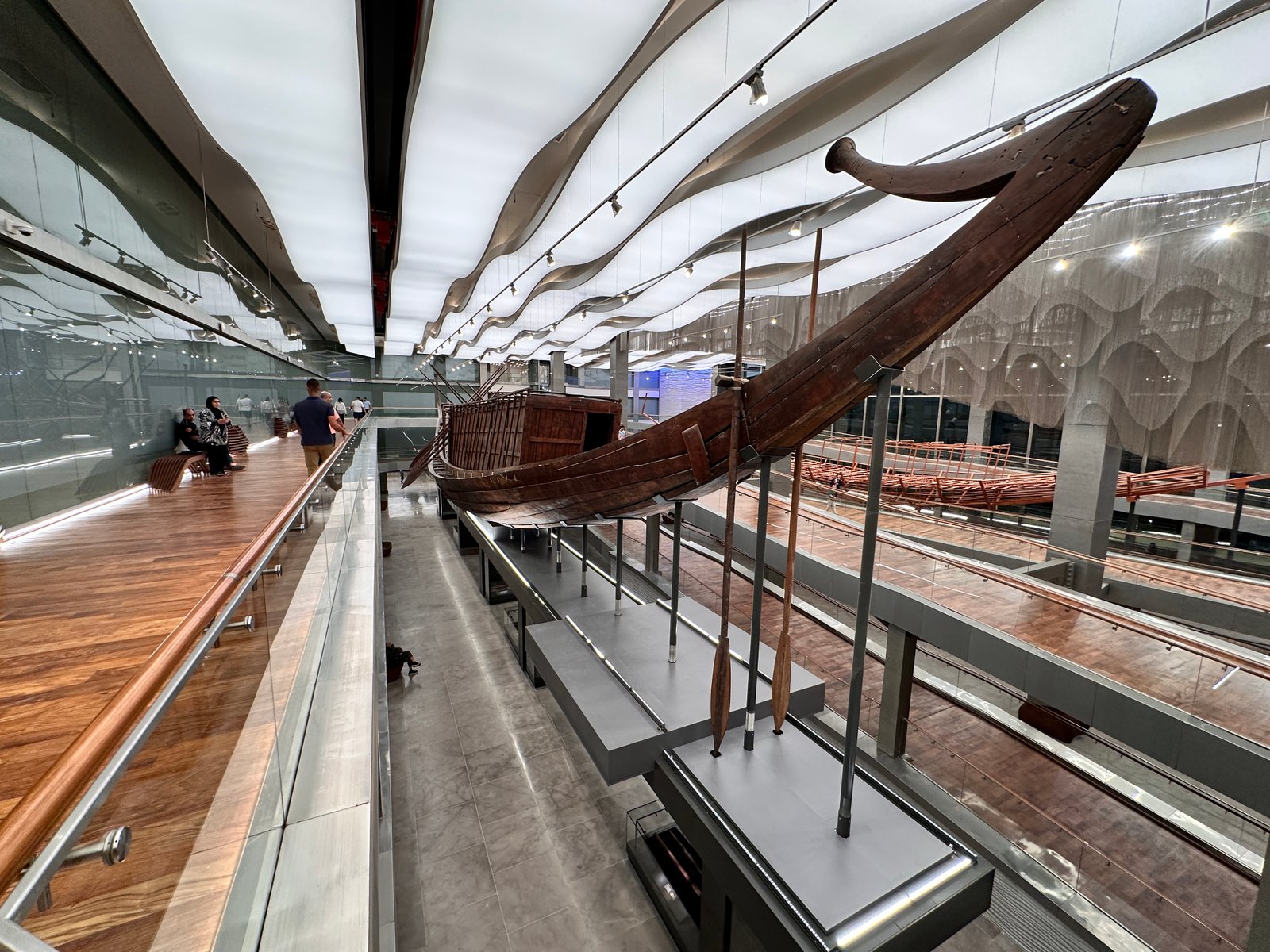
Khufu’s first reconstructed boat, more than 42 meters long, now has its own dedicated museum experience on the GEM campus. The second boat has also been transferred to the GEM for conservation and reconstruction.
The boats are Old Kingdom monuments and are not biblical artifacts, but they provide an exceptional window into Egyptian woodworking, rope technology, water transport, royal funerary practice, and the central importance of the Nile. For travelers trying to understand how ancient Egypt actually functioned, this section adds a technological dimension that the stone monuments alone cannot provide.
The Grand Hall serves as the transition into all of this. The colossal statue of Ramesses II dominates the entrance, while other monumental royal objects immediately establish the scale of Egyptian kingship before you begin the climb through the Grand Stairs or enter the galleries.
A Biblical Archaeology Route Through the GEM
You do not need every object in the museum to have a direct biblical connection. A better approach is to follow a handful of historically important stops that progressively build the world behind the biblical narrative.
Begin With Egyptian Kingship
Start by looking at the scale and presentation of royal monuments. The colossal Ramesses II and the royal sculpture of the Grand Stairs help explain the political and religious ideology embodied in the title Pharaoh.
Joseph’s Egyptian World
Pay special attention to the 12th Dynasty. Look for royal material associated with Senusret I, Amenemhat III, Hawara, and the Fayum, along with the museum reproduction of the Aamu procession from Beni Hasan. These objects help establish the Middle Kingdom world in which we place Joseph.
Avaris, the Hebrews, and the Hyksos
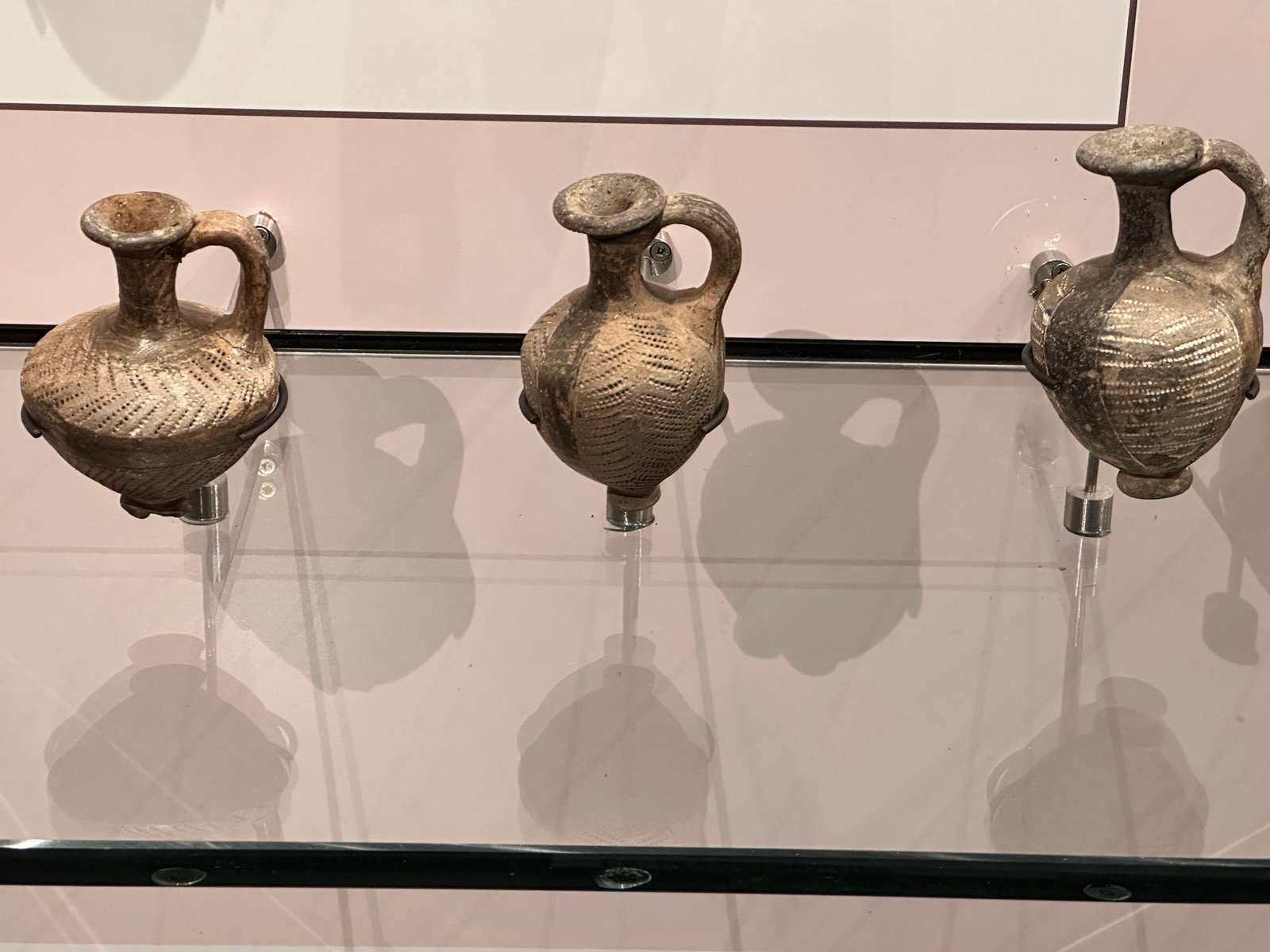
Look for the Tell el-Yahudiya Ware from Avaris (Tell el-Dab’a) and related material dealing with western Asiatic populations in the eastern Delta. These displays are especially important in our reconstruction because we identify the biblical Hebrews as the foundational population behind the Hyksos. In our reconstruction, the Hyksos begin primarily with the Hebrew population in Egypt and later develop into a more mixed Semitic and Levantine population as other groups become incorporated.
Kamose, Ahmose I, and the Fall of Hyksos Rule
The museum’s material connected with Kamose’s wars against the Hyksos helps bridge the political transition from the Hyksos world into the early New Kingdom. Kamose began the final Theban offensive, and his successor Ahmose I completed the defeat of Avaris and pursued the defeated Hyksos population to Sharuhen in southern Canaan.
In our historical reconstruction, Ahmose I is the leading candidate for the “new king” of Exodus 1 who did not know Joseph. We understand his victory over the Hyksos as the political break that transformed the formerly powerful Hebrew population of the eastern Delta into a subject population and set the stage for the oppression and enslavement described at the beginning of Exodus.
Amenhotep II and the Exodus Framework
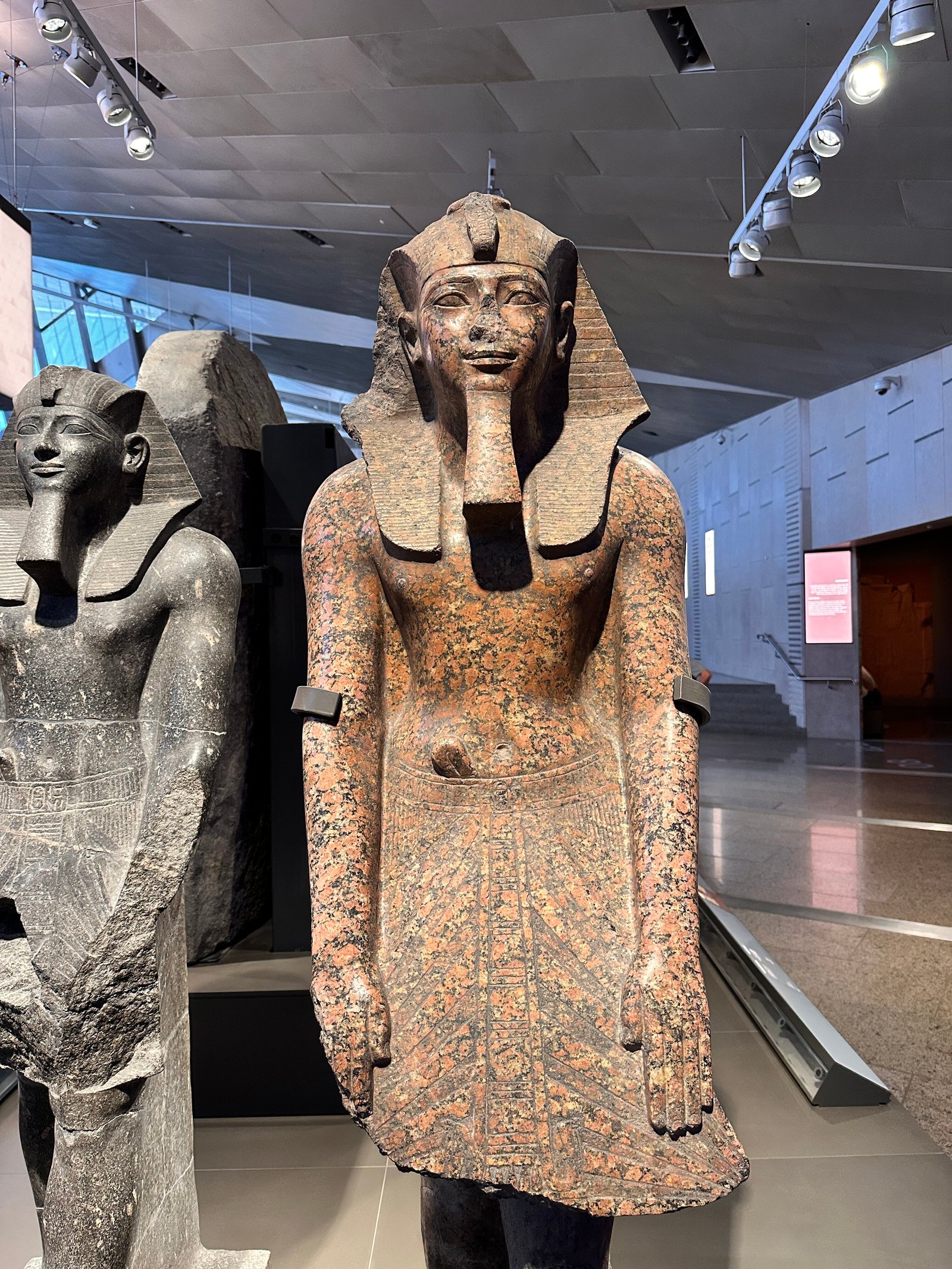
Seek out the granite statue of Amenhotep II, GEM 3796, from Karnak. Amenhotep II is our preferred candidate for the Pharaoh of the Exodus, making this one of the most immediately relevant royal objects in the museum for our historical reconstruction.
New Kingdom Material Culture
Study the chariots, weapons, furniture, captive imagery, ceremonial objects, and royal equipment from KV62. They do not identify a biblical event, but they make the military and courtly world of New Kingdom Egypt much more tangible.
Why We Connect the Hebrews and the Hyksos
This identification is not a modern idea invented to force the biblical account into Egyptian history. In the first century AD, Josephus explicitly argued that the Hyksos or “shepherds” described by the Egyptian historian Manetho were the ancestors of the Jewish people. In Against Apion, Josephus connects Manetho’s shepherd population with Joseph and his family, Avaris, and a later departure from Egypt toward the land of Judea. Josephus was writing many centuries after the events, so his argument is not direct contemporary evidence, but it preserves an important ancient Jewish interpretation of the Hyksos tradition.
Modern archaeology has made that older identification more interesting. Excavations at Tell el-Dab’a, ancient Avaris, document a substantial western Asiatic population in the eastern Nile Delta beginning in the late Middle Kingdom and continuing into the Second Intermediate Period. Archaeologists working at the site have traced Levantine settlement, burial customs, architecture, religious practices, and material culture across the period that eventually produced Hyksos rule. The Austrian Archaeological Institute has described this western Asiatic population as living at Avaris from the late 12th Dynasty onward and becoming responsible for the later Hyksos regime.
Our working reconstruction therefore sees a historical continuity rather than two unrelated populations: the Hebrews who entered Egypt in the age of Joseph formed the foundation of the population later known as the Hyksos. Other Semitic and Levantine groups were certainly present in the eastern Delta and, in our reconstruction, became increasingly incorporated into that population over time. That does not mean every inhabitant of Avaris was an Israelite, nor that every person ruled by the Hyksos kings was Hebrew. It means that the biblical family of Israel, the expanding Asiatic population of the eastern Delta, and the rise of the Hyksos are best understood as connected parts of the same historical development.
For the ancient literary testimony, see Josephus, Against Apion I. For the archaeological background, see the Austrian Archaeological Institute’s work at Tell el-Dab’a / Avaris and our own article, Avaris: The Forgotten Capital of the Hebrews in Egypt.
What the Museum Teaches Beyond Individual Artifacts
Pharaoh and Royal Power
Colossal royal images, throne names, victory scenes, and temple inscriptions communicated power, order, divine favor, and the king’s place at the center of Egyptian society. That setting gives added force to the Exodus narrative, where Moses confronts a ruler embedded in one of the ancient world’s most powerful ideological systems.
Egyptian Religion
The galleries make the Egyptian religious world visible through temple ritual, sacred images, priesthood, funerary texts, divine kingship, and beliefs about the afterlife. This gives concrete historical context to biblical passages that contrast the God of Israel with the religious claims and images of Egypt.
Daily Life and Administration
Objects connected with agriculture, scribal work, construction, food production, textiles, tools, and household life help reconstruct the systems behind Joseph’s administration, grain storage, labor, livestock, and Egypt’s large bureaucracy. See also our study of mudbrick construction and “bricks without straw.”
Chronology
The museum physically separates periods that are often blurred together in popular treatments of Egypt. Learning to recognize the Middle Kingdom, Second Intermediate Period, and New Kingdom helps keep discussions of Joseph, the Hyksos, Moses, and the Exodus historically precise.
Pair the Museum With the Archaeological Sites
The GEM becomes even more valuable when paired with the places where the artifacts came from. Giza explains pyramid-era kingship. Saqqara provides tombs, inscriptions, and the development of monumental architecture. The eastern Delta adds the geography of Goshen, Avaris, Pi-Ramesses, and Tanis. Luxor and Karnak reveal the scale of New Kingdom temple religion and royal power.
Museum Object Research
For a documented Middle Kingdom scene presented in the museum, see The Aamu Procession at Beni Hasan, which distinguishes the original tomb painting from the GEM reproduction.
For object-level documentation, use the Egypt Museum Artifact Index. It records identified objects photographed in Egyptian collections with ruler or individual, dynasty or period, provenance, museum location, inventory number, visible photographic context, and source image.
Visit the Grand Egyptian Museum
The Grand Egyptian Museum is featured in several of our Christian group itineraries, including Biblical Egypt Highlights – 7 Days, Foundations of Faith – 10 Days, and The Grand Egypt Experience – 15 Days.
For more place-based resources connecting Egypt’s archaeology with the historical world of Scripture, return to the Biblical Egypt Travel Guide.