


Bricks Without Straw?
Mudbrick Construction in Ancient Egypt and the Biblical Exodus
In the hot, dry lands of ancient Egypt, stone wasn’t the only building material of choice. In fact, most of the structures that supported daily life—from homes and palaces to granaries and temples—were not made of stone at all, but of something far more humble: mudbrick. For thousands of years, Egyptians shaped the Nile’s rich silt into bricks using molds, water, and a vital binding agent—chopped straw. This material not only made the bricks more durable but helped prevent cracking as they dried under the scorching Egyptian sun.
It’s here that archaeology and Scripture intersect in fascinating and affirming ways.
According to the biblical account in Exodus 5, the Israelites, while enslaved in Egypt, were forced to make mudbricks for Pharaoh’s construction projects. But when Moses confronted Pharaoh with God’s command to let His people go, the Egyptian ruler retaliated by intensifying their labor. He commanded that no straw be given to the Israelites, saying:
“You shall no longer give the people straw to make bricks as in the past; let them go and gather straw for themselves.” (Exodus 5:7, ESV)
This passage has often been misunderstood or misquoted. The Hebrews were not forced to make bricks without straw—doing so would have been counterproductive and structurally unsound. Rather, they were required to make the same quota of bricks without being provided straw, meaning they had to find and gather the necessary material themselves, dramatically increasing their workload.
This detail aligns perfectly with what we know from Egyptian mudbrick construction techniques. Ancient builders routinely mixed clay with straw to improve cohesion. Without it, the bricks would crumble and disintegrate. So, the text of Exodus is historically consistent—not an exaggeration or myth, but a real depiction of construction practice and punishment.
A Monument of Mudbrick: The Pyramid of Hawara

Pyramid entrance at Hawara, Egypt
One striking archaeological example of large-scale mudbrick use is the Pyramid of Amenemhat III at Hawara, located near the Faiyum region. Dating to the Middle Kingdom (12th Dynasty), this structure is largely built of mudbrick, with only parts of the inner core and burial chamber encased in limestone. Amenemhat III is often identified as a possible Pharaoh during the time of Joseph—shortly after the Hebrew patriarch rose to prominence in Egypt (Genesis 41).
Joseph’s leadership during the seven years of plenty is closely tied in Genesis 41 to the collection and storage of grain. Mudbrick was widely used for Egyptian domestic, administrative, and storage architecture, so it provides useful material context for the kind of infrastructure the biblical account describes. The surviving remains at Hawara should not, however, be presented as Joseph’s granaries or as direct physical evidence for Genesis 41.
Fast-forward to the New Kingdom, particularly the 18th Dynasty, and we see Egyptian expansion in the Delta region where the cities of Pithom and Raamses were constructed—identified in Exodus 1:11 as storage cities built by the enslaved Hebrews. Excavations at Tell el-Retaba have revealed 18th-Dynasty storage structures that fit remarkably well with the biblical description of store cities in this eastern Delta setting. Qantir/Avaris likewise preserves large-scale mudbrick construction in the broader region associated with Raamses.
Mudbrick as a Link Between the Text and the Terrain
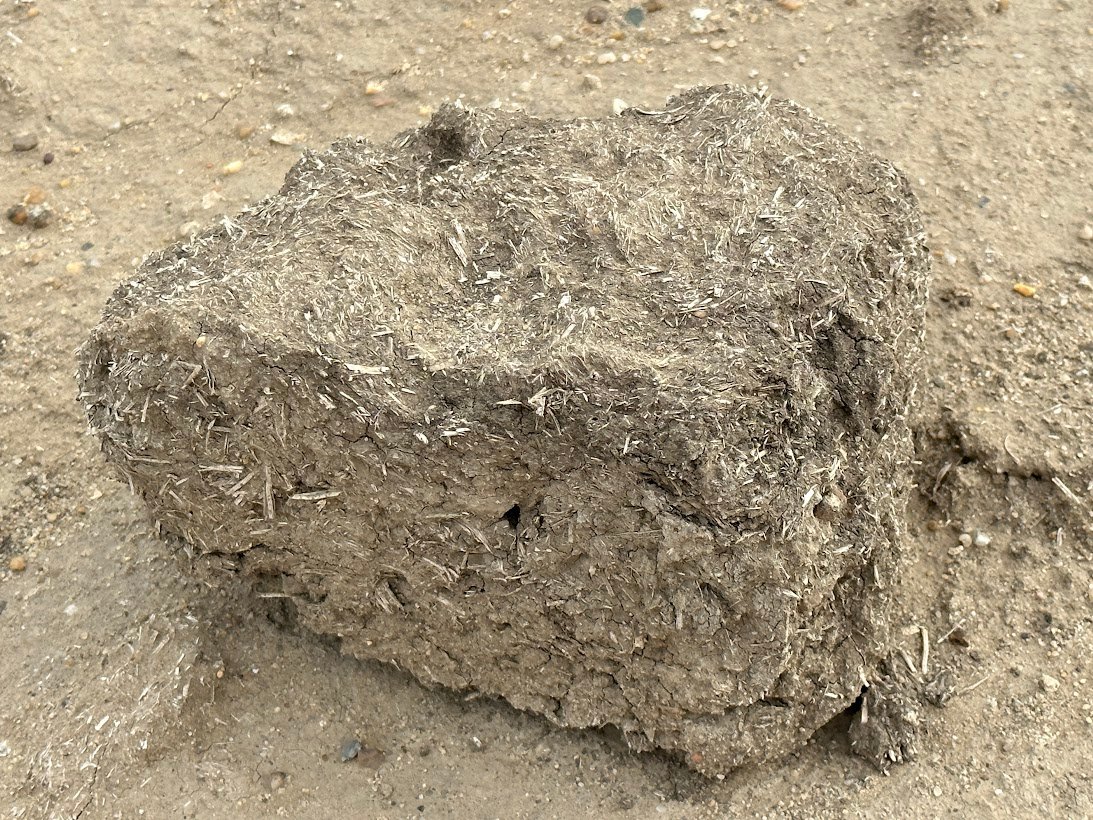
Hawara pyramid mud-and-straw brick
Holding a mudbrick from Hawara in your hand, you’re gripping a piece of biblical-era history. These bricks connect the labor of everyday life in ancient Egypt with the drama of divine deliverance. They are the very substance of the Hebrew experience in bondage—molded with sweat, shaped under oppression, and yet remembered in Scripture with stunning accuracy.
What the Bible records and what archaeology reveals come together in these sunbaked bricks. They are not symbols of myth or metaphor, but markers of truth—testifying to the reliability of the biblical account and the resilience of a people who, even in slavery, clung to a greater promise. For me, this is one of those places where a simple piece of ancient material culture makes the biblical world feel suddenly tangible.

For the eastern-Delta setting behind this discussion, see Avaris and the Hebrews in Egypt and our study of the Hyksos-era settlement at Tell el-Ku’a.
Research Sources and Further Reading
Primary biblical passage: Exodus 5 (ESV). Scripture is cited in the text rather than treated as a bibliography entry.
- Global Egyptian Museum. “Mud Bricks.” Online reference. Overview of ancient Egyptian mudbrick manufacture, including the use of Nile mud and added straw or other organic material.
- Metropolitan Museum of Art. “Brick Stamped with the Names of Amenhotep III.” Collection record. A documented New Kingdom mudbrick object illustrating Egyptian brick construction.
- Petrie, W. M. Flinders. Hawara, Biahmu, and Arsinoe. London: Field & Tuer, 1889. Petrie’s excavation publication for Hawara and the pyramid complex of Amenemhat III.
- Rzepka, Sławomir, Mustafa Nour el-Din, Anna Wodzińska, and Łukasz Jarmużek. “Egyptian Mission Rescue Excavations in Tell el-Retaba. Part 1: New Kingdom Remains.” Ägypten und Levante 22 (2012): 253–287. Article copy. Excavation report documenting New Kingdom settlement remains, mudbrick architecture, and silos at Tell el-Retaba.

Efrén Giraldo Toro
Excelentes sus artículos. Este tema de los hebreos en Egipto me ha llamado la atención, aunque no pertenezco a alguna religión, yo creo firmemente en la Biblia. Y siempre dije: algún día la arqueología debe descubrir en el propio Egipto vestigios arqueológicos de los hebreos en su paso por allí o incluso en Mar Rojo restos del ejercito del Faraón.
He escrito varios libros sobre civilizaciones antiguas y contactos con América precolombina próximos a publicar.