
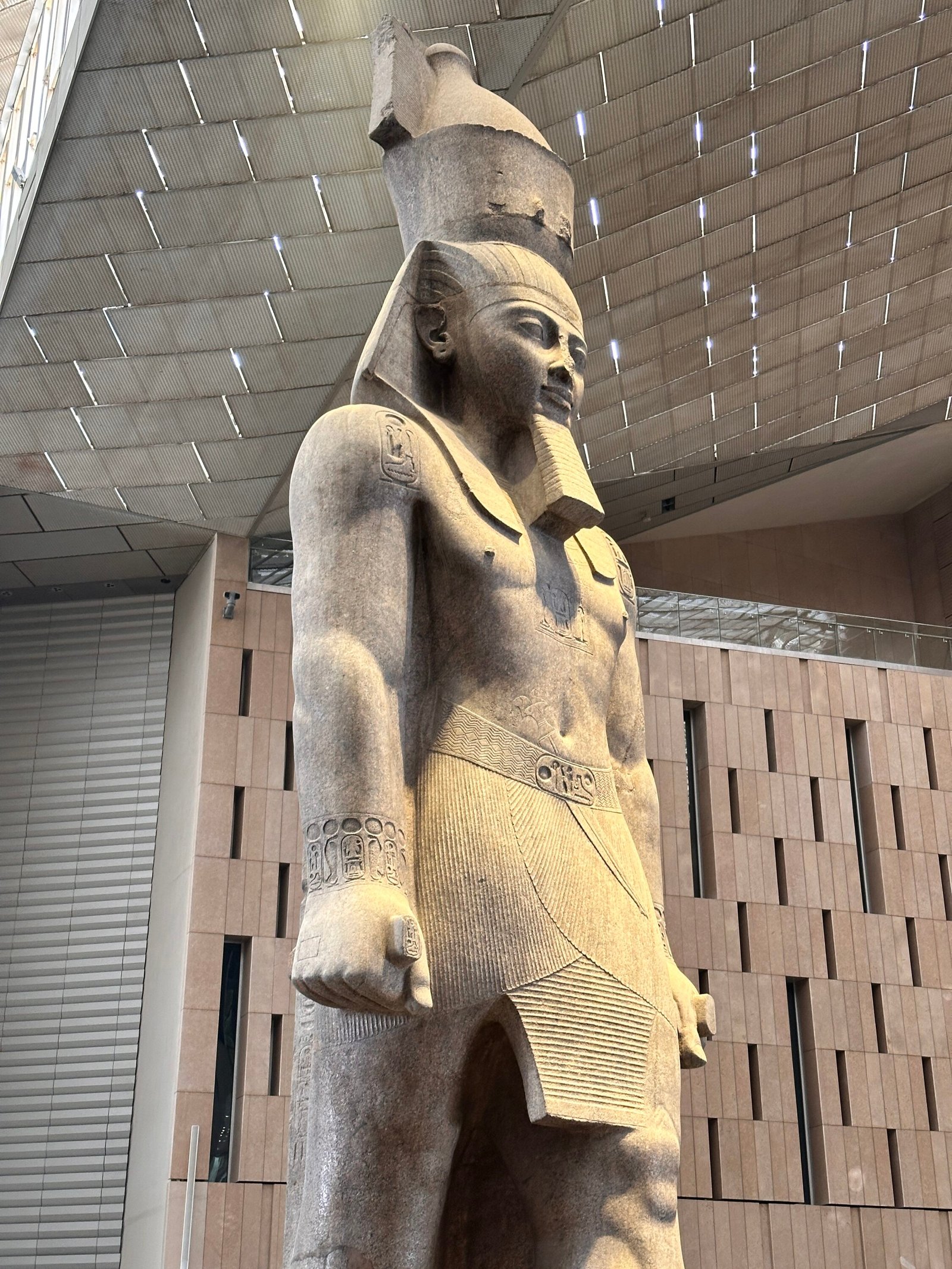
The colossal granite statue cataloged as GEM 1 is one of the signature monuments of the Grand Egyptian Museum. Standing 11.35 meters high, the statue represents Ramesses II and originally stood outside the main temple of the god Ptah at Memphis, modern Mit Rahina. It now dominates the Grand Hall of the museum in Giza.
Key Facts
- Object: Colossal standing statue of Ramesses II.
- Inventory number: GEM 1.
- Ruler: Ramesses II.
- Period: 19th Dynasty, New Kingdom.
- Material: Granite.
- Height: 11.35 meters.
- Provenance: Memphis (Mit Rahina), originally outside the main Temple of Ptah.
- Current location: Grand Hall, Grand Egyptian Museum, Giza.
- Royal children: Prince Khaemwaset and Princess Bintanath are carved behind the king’s legs.
A Colossus from the Temple of Ptah at Memphis
The Grand Egyptian Museum’s official catalog record identifies the statue as GEM 1, gives its Memphis provenance and granite material, and records its height as 1,135 centimeters. The museum explains that the monument originally stood outside the main temple of Ptah, guarding the sacred space.
Memphis was one of ancient Egypt’s great religious and administrative centers, and Ptah was its principal deity. Ramesses II invested heavily in the city and its temples, making this colossal royal image part of a larger program connecting the king with Memphis and its divine cult.
Khaemwaset and Bintanath Behind the King’s Legs
Two smaller royal figures are carved behind Ramesses II’s legs. The official GEM record identifies them as Prince Khaemwaset and Princess Bintanath. Their inclusion embeds family and dynastic continuity within the colossal image of the king.
Khaemwaset is especially significant in the history of Memphis. He served as High Priest of Ptah and became closely associated with the monuments and cults of the Memphite region. His presence on the colossus is therefore more than a generic family portrait: it connects one of Ramesses II’s most prominent sons directly with the religious center where the statue originally stood.
From Memphis to the Grand Egyptian Museum
The statue has become one of the visual anchors of the Grand Egyptian Museum. Its modern display allows visitors to walk around the monument and view it at multiple levels within the immense Grand Hall, making details that would have been difficult to see at ground level more accessible.
For a broader guide to the collection and biblical-history context of the museum, see the Grand Egyptian Museum Christian Traveler’s Guide.
Do Not Confuse GEM 1 with the Fallen Limestone Colossus at Memphis
Memphis preserves another famous colossal image of Ramesses II: a reclining or fallen limestone colossus displayed at the Mit Rahina open-air museum. It is a different monument. GEM 1 is the standing granite statue now in Giza.
The distinction matters because photographs, captions, and travel articles sometimes use “colossus of Ramesses II at Memphis” without specifying which statue is meant. Inventory number GEM 1, granite material, and the current Grand Egyptian Museum location provide an unambiguous identification for the monument discussed here.
Evidence and Interpretation
Secure evidence: GEM 1, Ramesses II, 19th Dynasty, granite material, 11.35-meter height, Memphis/Temple of Ptah provenance, and the identifications of Khaemwaset and Bintanath are supplied by the Grand Egyptian Museum’s official catalog.
Interpretive context: the statue clearly expresses royal scale, authority, and temple presence. Claims about the precise ritual experiences of ancient worshippers should be distinguished from the secure object-level catalog data.
For another recently documented monument of this king in Cairo, see our report on the restored basalt stele of Ramesses II at the Egyptian Museum.
Sources and Further Reading
See also the Egypt Museum Artifact Index for additional specifically identified museum objects.