Hyksos-Era Village in Ismailia May Be Connected to the Biblical Exodus
Ten mudbrick tombs, a residential complex, silos, ovens, and Tell el-Yahudiya Ware add new evidence for Hyksos-period life in Wadi Tumilat.
DATE: June 29, 2026
SUBJECT: Hyksos-era tombs, settlement, storage and production facilities at Tell el-Ku’a
LOCATION: Wadi Tumilat, Ismailia Governorate, Egypt
A newly announced archaeological discovery at Tell el-Ku’a, in Wadi Tumilat within modern Ismailia Governorate, is adding an important new piece to the picture of the eastern Nile Delta during the Second Intermediate Period. The site itself is not in the modern city of Ismailia. It lies farther west in the Wadi Tumilat corridor, roughly 36 km west of Ismailia city and about 8 km east of Tell el-Kebir. On June 29, 2026, Egypt’s Ministry of Tourism and Antiquities announced that an Egyptian archaeological mission working at Tell el-Ku’a in Wadi Tumilat had uncovered a group of tombs, a substantial residential area, ovens, storage silos, and a range of artifacts associated with the Hyksos era.
The most striking part of the announcement is the discovery of ten mudbrick tombs specifically dated by the excavation team to Egypt’s 15th Dynasty. That dynasty is the political period most closely associated with Hyksos rule in the eastern Delta. The Hyksos themselves were a largely Semitic population centered in the eastern Delta, and their relationship to the biblical Hebrews has been discussed for centuries. Already in the first century AD, the Jewish historian Josephus, drawing on the Egyptian priest Manetho, explicitly identified the Hyksos or “Shepherds” expelled from Egypt with the ancestors of his own Jewish people. In the historical reconstruction followed here, the Israelite Hebrews formed the principal population stream that rose in number and influence in the eastern Delta and came to be remembered historically as the Hyksos, although other Semitic groups were also present in the region.
The tombs at Tell el-Ku’a therefore belong to a cultural and political setting that is especially significant for biblical history. They vary in size and orientation, with some described as rectangular mastaba-like structures and others preserving architectural façades and decorative elements.
A Hyksos-Period Community, Not Just a Cemetery
The discovery is significant because Tell el-Ku’a is revealing more than a burial ground. Archaeologists also uncovered a residential complex measuring approximately 30 by 60 meters, enclosed by a mudbrick wall about 1.5 meters thick. Inside were organized architectural units containing halls and rooms of varying sizes. To the east of the residential area, the team identified multiple ovens and silos used for storage.
That combination of houses, storage facilities, production areas, and burials is helping archaeologists reconstruct Tell el-Ku’a as an integrated community rather than an isolated settlement. Egypt’s Minister of Tourism and Antiquities, Sherif Fathy, emphasized that the site offers a clearer picture of settlement organization in the eastern Delta during the Second Intermediate Period.
Tell el-Yahudiya Ware and Eastern Delta Connections
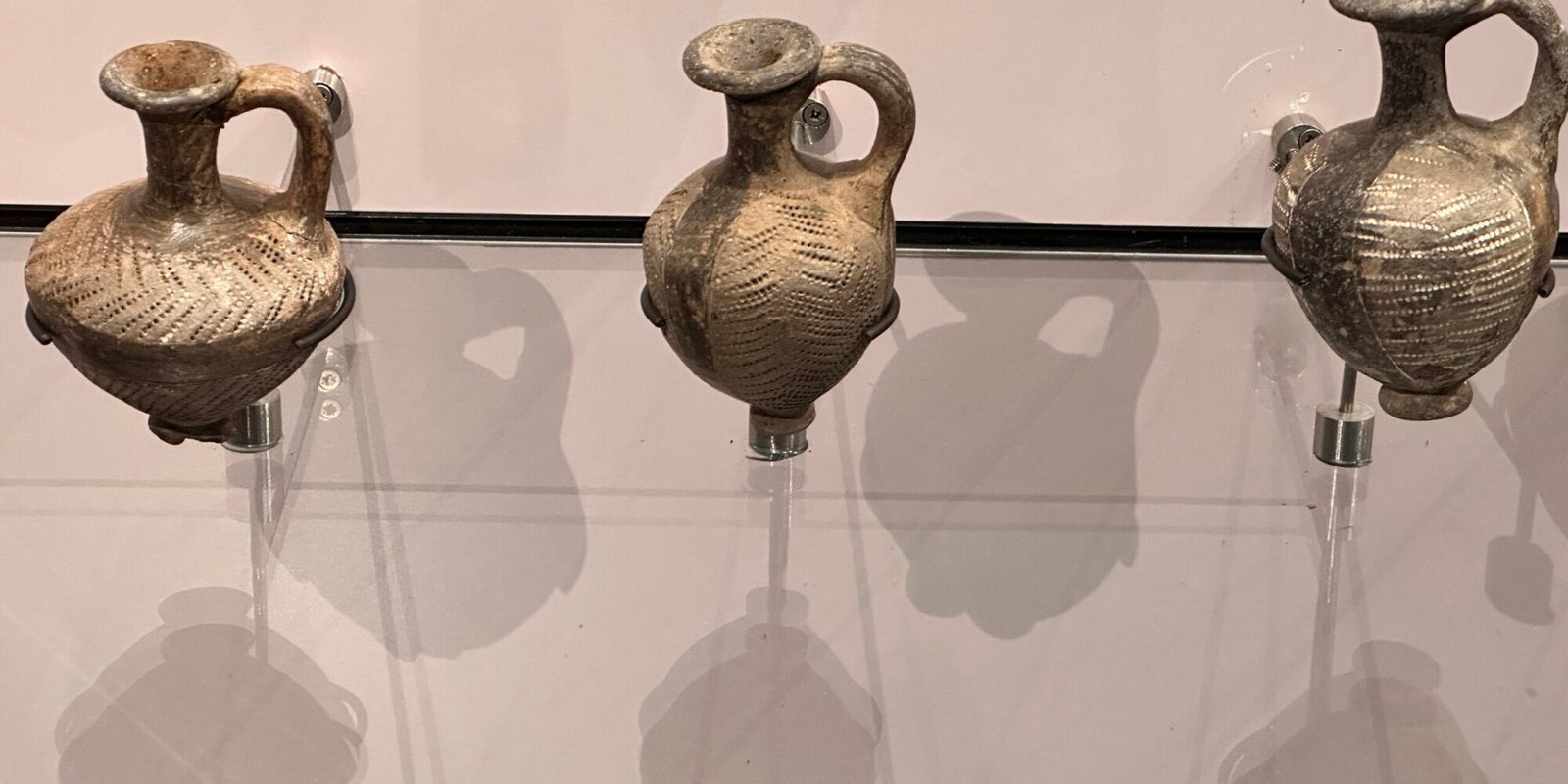
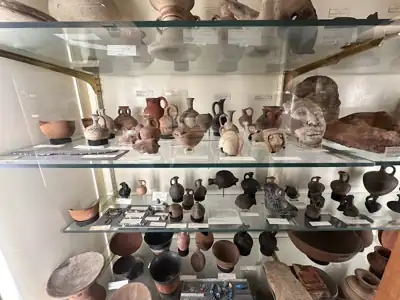
Among the artifacts recovered were scarabs, bronze tools, pottery vessels, alabaster cosmetic containers, and distinctive bottles belonging to the Tell el-Yahudiya Ware tradition. This decorated ceramic type is closely associated with the Middle Bronze Age and Second Intermediate Period and is widely found in archaeological contexts linking Egypt with the Levant.
The pottery is particularly useful because changing vessel forms and decorative styles can help archaeologists date settlement phases and trace connections between communities. Officials reported that some pottery from Tell el-Ku’a also carries production marks and seals suggesting broad exchange networks. The excavators have therefore raised the possibility that the site functioned as a distribution center or important point within regional trade.
An Unusual Burial Pattern
The mission also identified human burials outside the constructed mudbrick tombs for the first time at the site. Some individuals were buried in a crouched position, a pattern the excavation team described as unusual and worthy of additional study. Preliminary examination of the skeletal remains indicated adults ranging roughly from 25 to 40 years old, while large quantities of animal bones appear connected with both daily consumption and funerary practices.
These details may eventually help clarify who lived at Tell el-Ku’a and how burial practices changed across different parts of the community. Together with the settlement architecture and material culture, the burials add another layer to the picture of life in Wadi Tumilat during the Hyksos period.
Occupation Continued into the 18th Dynasty
One of the most important findings may be the evidence for continuity. According to the Ismailia excavation team, Tell el-Ku’a remained in use until approximately the middle of the 18th Dynasty. That means the settlement appears to have continued through the transition from Hyksos political rule into the early New Kingdom.
A Village from the Time of the Exodus?
The report that Tell el-Ku’a remained occupied until around the middle of the 18th Dynasty is especially striking within the biblical chronology that places the Exodus around 1446 BC, during the reign of Amenhotep II. In that reconstruction, this village belongs to the same broad historical moment in which the Israelite Hebrews would have departed Egypt.
That raises an intriguing possibility. Tell el-Ku’a may preserve one of the eastern-Delta communities affected by the Exodus itself. The settlement could have included Hebrews, or it may have been home to people who later joined Israel as part of the “mixed multitude” that left Egypt with them in Exodus 12:38. If occupation at the site truly ends around this point in the 18th Dynasty, the timing deserves close attention as excavation continues.
Seen this way, Tell el-Ku’a may offer more than a snapshot of Hyksos-period life. It may preserve part of the human landscape from which the Exodus unfolded—a settled community in Wadi Tumilat with houses, storage facilities, ovens, trade connections, and a population whose story appears to continue right up to the middle of the 18th Dynasty.
Why Wadi Tumilat Matters
Satellite view of Tell el-Ku’a in Wadi Tumilat, approximately 8 km east of Tell el-Kebir.
Tell el-Ku’a lies in the Wadi Tumilat corridor, west of the modern city of Ismailia and near the Qassasin–Tell el-Kebir area. The archaeological mound covers about 55 feddans, or roughly 23 hectares. In regional terms, it sits only about 6.7 km southwest of Tell el-Retaba, a site frequently identified with biblical Pithom, about 39 km east of Tell Basta/Bubastis, where Tell el-Yahudiya Ware is also known, and about 32 km south of Avaris at Tell el-Dab’a. The corridor itself formed one of the most important natural routes connecting the eastern Nile Delta with Egypt’s eastern frontier, Sinai, and the Levant.
That geography makes the discovery especially interesting for the study of biblical Egypt. Tell el-Ku’a sits within a tight eastern-Delta network: Avaris at Tell el-Dab’a to the north, Tell Basta/Bubastis to the west, and Tell el-Retaba only a few kilometers to the northeast. These sites are all part of the wider landscape in which Semitic populations, Tell el-Yahudiya Ware, Hyksos-period settlement, and later New Kingdom occupation can be traced. Wadi Tumilat also figures prominently in discussions of the land of Goshen, Pithom, and routes leading eastward from Egypt.
That broader eastern-Delta setting is also where the biblical story places the Israelites during their years in Egypt. Genesis describes Jacob’s family settling in the land of Goshen, while Exodus later remembers a large Hebrew population living and laboring in this same eastern region. Tell el-Ku’a therefore adds useful archaeological texture to the world described in those accounts: substantial communities, storage facilities, trade connections, and long-lived settlement along the corridor between the Nile Delta and Egypt’s eastern frontier.
For readers following the archaeology of Goshen, Avaris, Pithom, and the Exodus, discoveries such as this are valuable because they continue to fill in the human landscape of the eastern Delta. Tell el-Ku’a joins a growing network of sites showing just how active and densely connected this region was during the centuries surrounding Hyksos rule and the rise of the New Kingdom.
For researchers following the Hyksos and the eastern Delta, Tell el-Ku’a is now a site worth watching closely. Its combination of residences, storage facilities, production areas, Levantine-connected pottery, burial grounds, and continued occupation into the New Kingdom may prove especially valuable as excavation continues.
Tell el-Ku’a is a site worth watching as excavation continues. Sites in this corridor can add small but important pieces to the larger picture of biblical Egypt, and this one sits in exactly the kind of place where another season of excavation could matter.
For the larger biblical-geography discussion surrounding this corridor, see Where Did Israel Cross the Red Sea? and our study of Avaris and the Hebrews in Egypt.
Research Sources and Further Reading
- State Information Service of Egypt. “Discovery of Tombs, a Residential Area, and Production Facilities at Tell el-Kuʿa in Ismailia.” June 29, 2026. Official announcement.