Old Kingdom Tomb of Sekhentyu-Ptah Discovered at Saqqara
An inscribed false door, alabaster ritual objects, burial shafts, sealed sarcophagi, and more than 100 ushabti figures are adding a new chapter to the archaeology of Saqqara.
DATE: August 29, 2026
SUBJECT: Discovery of the Old Kingdom tomb of Sekhentyu-Ptah
LOCATION: Sector A West, Bubasteion Necropolis, Saqqara, Egypt
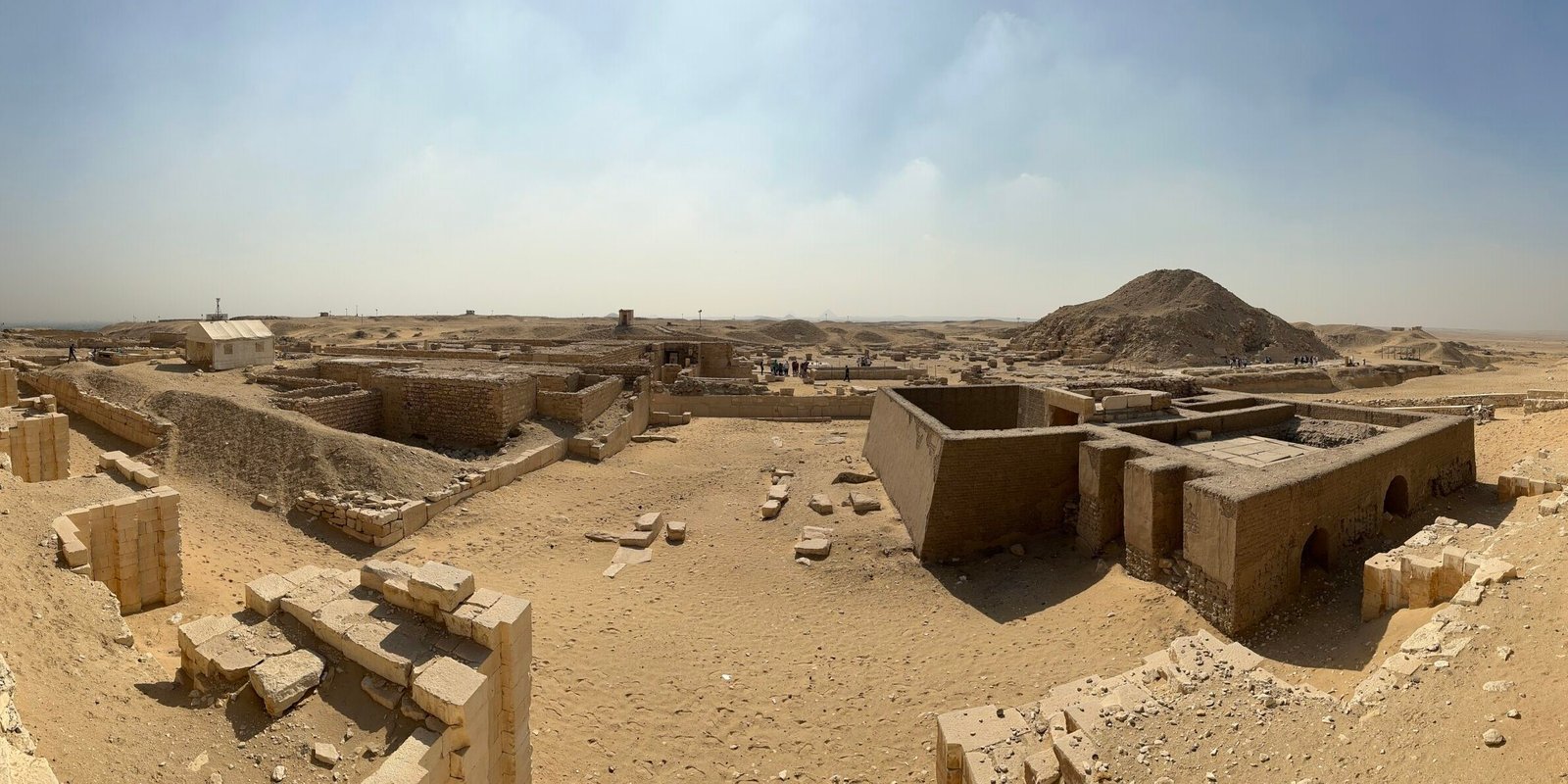
An Egyptian archaeological mission working at Saqqara has announced the discovery of the tomb of Sekhentyu-Ptah, a high-ranking official of Egypt’s Old Kingdom whose name and titles survive in hieroglyphic inscriptions inside his funerary chapel. The tomb was uncovered during the mission’s first excavation season in Sector A, west of the Bubasteion necropolis, together with a network of burial shafts containing later burials and a substantial collection of funerary material.
The discovery is important not simply because another tomb has been found at Saqqara, but because several key elements of Sekhentyu-Ptah’s burial remain in their archaeological context. The chapel’s false door was preserved in its original position, and immediately in front of it archaeologists found a group of alabaster ritual objects inscribed with his name and titles. That combination gives researchers something especially valuable: a named Old Kingdom official, his funerary architecture, and a group of ritual objects still associated with the place where they were originally used.
A Named Official and His Funerary Chapel
The surviving chapel contains the false door that formed one of the most important symbolic features of an elite Egyptian tomb. In Egyptian funerary belief, the false door marked the point through which the deceased could symbolically receive offerings from the living. In front of Sekhentyu-Ptah’s false door, the excavation team uncovered an alabaster offering table, an offering disc, a purification basin, a jug, and another basin or wash vessel.
According to the official announcement, these objects bear hieroglyphic inscriptions identifying Sekhentyu-Ptah and preserving a remarkable series of titles. He is described as Royal Chamberlain, Overseer of All the Works of the King, Overseer of Royal Documents, Keeper of the Secrets of Royal Decrees, Priest of the Goddess Maat, and Overseer of the Scribes.
Those titles place him close to the administrative machinery of the Old Kingdom state. Oversight of royal documents and scribes points toward the highly literate world of record keeping and government administration, while responsibility for the king’s works suggests involvement in major royal projects. The announcement does not yet identify a specific dynasty or reign for Sekhentyu-Ptah, so it is better to leave his career within the broader Old Kingdom until the excavation team publishes more precise chronological evidence.
Why the Objects in Front of the False Door Matter
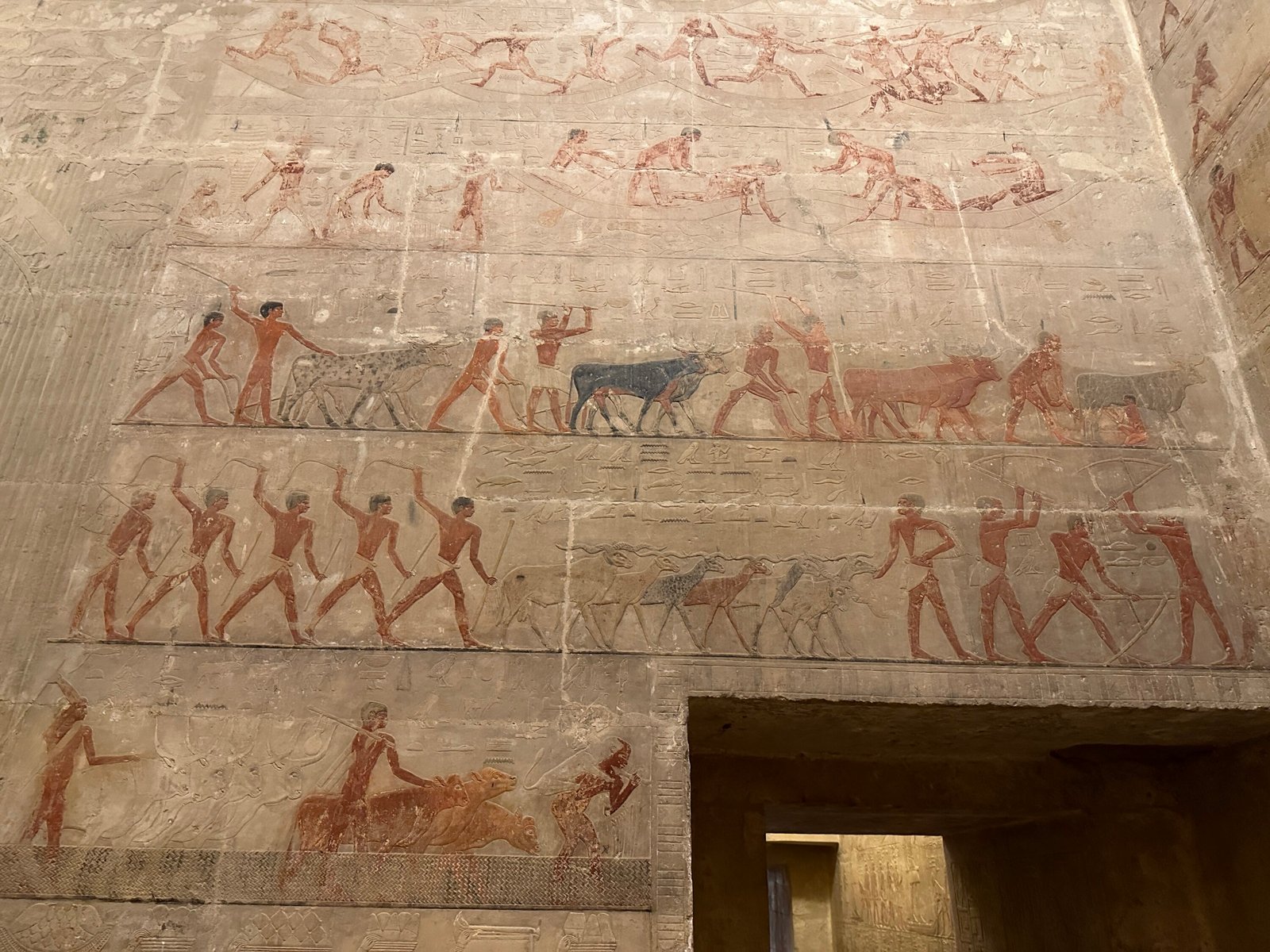
Mohamed Abdel Badie, head of Egypt’s antiquities sector, emphasized the importance of discovering the ritual assemblage together and in place. Archaeology gains much of its value from context. An inscribed vessel in a museum case can tell us something, but a complete group of objects still positioned within a funerary chapel can tell us much more about how that space functioned.
Here, the relationship between the false door and the alabaster ritual objects may help archaeologists reconstruct elements of the offering and purification practices carried out for Sekhentyu-Ptah. The inscriptions also tie those practices directly to a named individual rather than leaving the assemblage anonymous.
Hisham El Leithy, Secretary-General of the Supreme Council of Antiquities, said the mission’s work has included stratigraphic recording, architectural documentation, photography, digital documentation, linguistic study, and comparison with material from other sites. That broader program should eventually help place the tomb more precisely within the architectural and chronological development of the necropolis.
Later Burials Around an Old Kingdom Tomb
The Old Kingdom tomb is only one part of what the mission uncovered. Archaeologists also found an interconnected system of burial shafts containing numerous human burials, large quantities of painted funerary cartonnage, more than 100 faience ushabti figures, three stone sarcophagi still reported as sealed, a wooden falcon figure, pottery vessels, and other objects.
It is important not to treat all of these finds as though they belonged to Sekhentyu-Ptah’s original Old Kingdom burial. The excavation team specifically interprets the surrounding shafts as evidence that this part of the Saqqara necropolis continued to be reused in later periods. Painted cartonnage and ushabti figures belong to funerary traditions that became especially prominent long after the Old Kingdom.
Amr El Tayebi, director of the Saqqara archaeological site and head of the mission, noted that the later material is especially useful for studying Late Period funerary practices and the changing use of the necropolis. Several shafts also show evidence of ancient robbery, including openings cut between burial chambers by tomb robbers. Even after that disturbance, however, enough material survives to reconstruct multiple phases in the history of this part of Saqqara.
Three Sarcophagi Still Sealed
Among the more eye-catching details in the announcement are the three stone sarcophagi that remain sealed. At this stage, the official reports do not identify the individuals inside or assign the sarcophagi to a more precise date. That makes them interesting, but it also means there is good reason to resist getting ahead of the archaeology.
What matters now is the excavation context. If the sarcophagi can be studied within well-recorded shaft sequences, their inscriptions, contents, human remains, and associated objects may help establish when these spaces were reused and how burial customs changed across the life of the necropolis.
Saqqara as a Cemetery Used Again and Again
That long history is part of what makes Saqqara so remarkable. The necropolis served ancient Memphis and remained important across an extraordinary span of Egyptian history. Kings, officials, priests, families, and later religious communities all left their mark on the desert plateau. New discoveries frequently sit beside, above, or even within spaces that had already been important centuries earlier.
This discovery captures that layered history unusually well. At its center is the Old Kingdom chapel of Sekhentyu-Ptah, with a named official, a false door, and inscribed ritual equipment. Around it are burial shafts that were used and reused much later. The result is not one frozen moment, but a sequence of moments preserved in the same landscape.
Why This Discovery Is Worth Watching
There is still much we do not know. The announcement does not yet give Sekhentyu-Ptah a more precise place within the Old Kingdom, and the later shafts and sealed sarcophagi remain under study. The mission says documentation, archaeological analysis, linguistic work, and scientific comparison will continue, with the results intended for publication in specialized research.
That is exactly why this is a discovery worth following. The first headline gives the name of a man and a list of impressive titles. The archaeology gives something richer: the physical place where his memory was maintained, the objects used in that setting, and the evidence of generations who returned to the same ground long after his burial.
Saqqara has a way of reminding us that an Egyptian tomb is rarely just about death. It can preserve administration, ritual, art, architecture, memory, reuse, robbery, and centuries of changing human behavior in one patch of desert. Sekhentyu-Ptah’s tomb has already given us several of those layers, and the most interesting part may be what the continuing study reveals next.
For more context on the development and long history of this necropolis, see The Step Pyramid of Djoser at Saqqara and our Saqqara and Biblical Egypt guide.
Sources
- Emirates News Agency. “Old Kingdom Tomb, 100 Ushabti Figurines Found at Egypt’s Saqqara.” August 29, 2026. Report.
- Finestre sull’Arte. “Egypt: An Important Tomb Discovered in Saqqara, Bearing the Names of the Deceased and Artifacts from the Old Kingdom.” August 29, 2026. Report.
- State Information Service of Egypt. “Old Kingdom Tomb Discovered at Egypt’s Saqqara Necropolis.” August 29, 2026. Official announcement.