
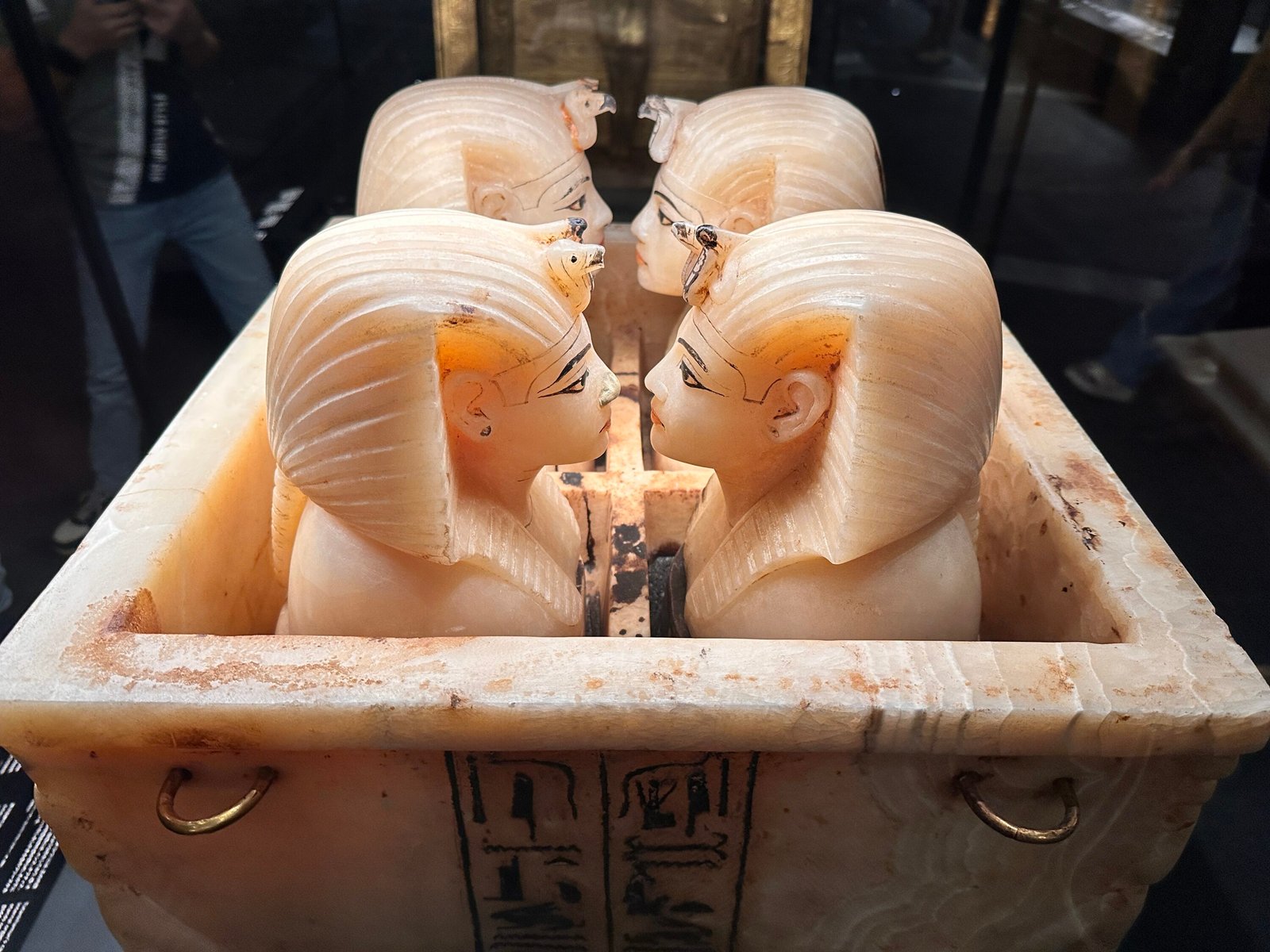
The travertine canopic chest cataloged by the Grand Egyptian Museum as GEM 10 formed part of the elaborate equipment protecting Tutankhamun’s internal organs. Hidden within a larger canopic shrine in tomb KV62, the chest combines royal portraiture, protective goddesses, ritual symbols, precious materials, and four internal compartments that originally held solid-gold miniature coffins.
Key Facts
- Object: Canopic chest of Tutankhamun.
- GEM number: GEM 10.
- Ruler: Tutankhamun.
- Period: 18th Dynasty, New Kingdom.
- Findspot: Tomb KV62, Valley of the Kings.
- Material: Travertine (Egyptian alabaster), gold, and pigment.
- Height: 85.5 cm.
- Length: 54 cm.
- Internal arrangement: Four cylindrical hollows, each originally containing a solid-gold miniature coffin.
- Protective goddesses: Isis, Nephthys, Selket, and Neith.
- Current location: Tutankhamun Galleries, Grand Egyptian Museum, Giza.
A Chest Hidden Inside a Larger Shrine
The Grand Egyptian Museum’s official catalog record identifies the object as GEM 10 and explains that Tutankhamun’s larger canopic shrine concealed this chest. The chest itself takes the form of a ritual shrine with a sloping lid that was tied in place with linen ropes and set on a gold-foil-covered wooden sledge.
This nested arrangement created multiple layers of physical and symbolic protection around the king’s embalmed organs.
Four Royal-Head Stoppers
The most immediately recognizable feature of GEM 10 is the group of four finely carved heads. Each stopper represents the king in idealized royal form and seals one of the four cylindrical hollows cut into the travertine chest.
Inside those hollows were four solid-gold miniature coffins containing Tutankhamun’s embalmed internal organs. Unlike the more familiar canopic jars with heads of the Four Sons of Horus, Tutankhamun’s chest uses four royal portrait heads as the visible stoppers.
Isis, Nephthys, Selket, and Neith
Four protective goddesses are carved in raised relief at the corners: Isis, Nephthys, Selket, and Neith. Their presence gives the chest a protective divine perimeter. Beneath them runs a decorative program incorporating djed pillars, symbols of stability, and tyet knots, symbols associated especially with protection and Isis.
The combination of royal portraiture and divine guardianship turns the chest into more than a container. It is part of the ritual system intended to preserve the king’s body and identity for the afterlife.
Material and Dimensions
The Grand Egyptian Museum identifies the material as travertine, often called Egyptian alabaster, with gold and pigment. The chest is approximately 85.5 cm high and 54 cm long. Those official measurements and the current GEM number provide a precise modern catalog identity for the object.
The Canopic Chest in the Tutankhamun Assemblage
Tutankhamun’s burial equipment is unusually valuable because so many objects survive together from a single royal tomb. That allows furniture, chariots, funerary containers, jewelry, weapons, clothing, ritual objects, and royal images to be studied as parts of one archaeological assemblage rather than isolated museum pieces.
For other securely identified objects from KV62, see Tutankhamun’s ceremonial chair and footstools and Tutankhamun’s second state chariot.
Evidence and Interpretation
Secure evidence: GEM 10, 18th-Dynasty date, Tutankhamun Galleries collection, travertine/gold/pigment materials, dimensions, four cylindrical hollows, royal-head stoppers, and the four protective goddesses are documented directly by the Grand Egyptian Museum.
Interpretive context: the chest’s imagery clearly belongs to Egyptian funerary protection and bodily preservation. Detailed reconstructions of the sequence of rituals performed around it should be distinguished from the secure physical and catalog evidence.
Source
See also the Egypt Museum Artifact Index and the Grand Egyptian Museum guide.