

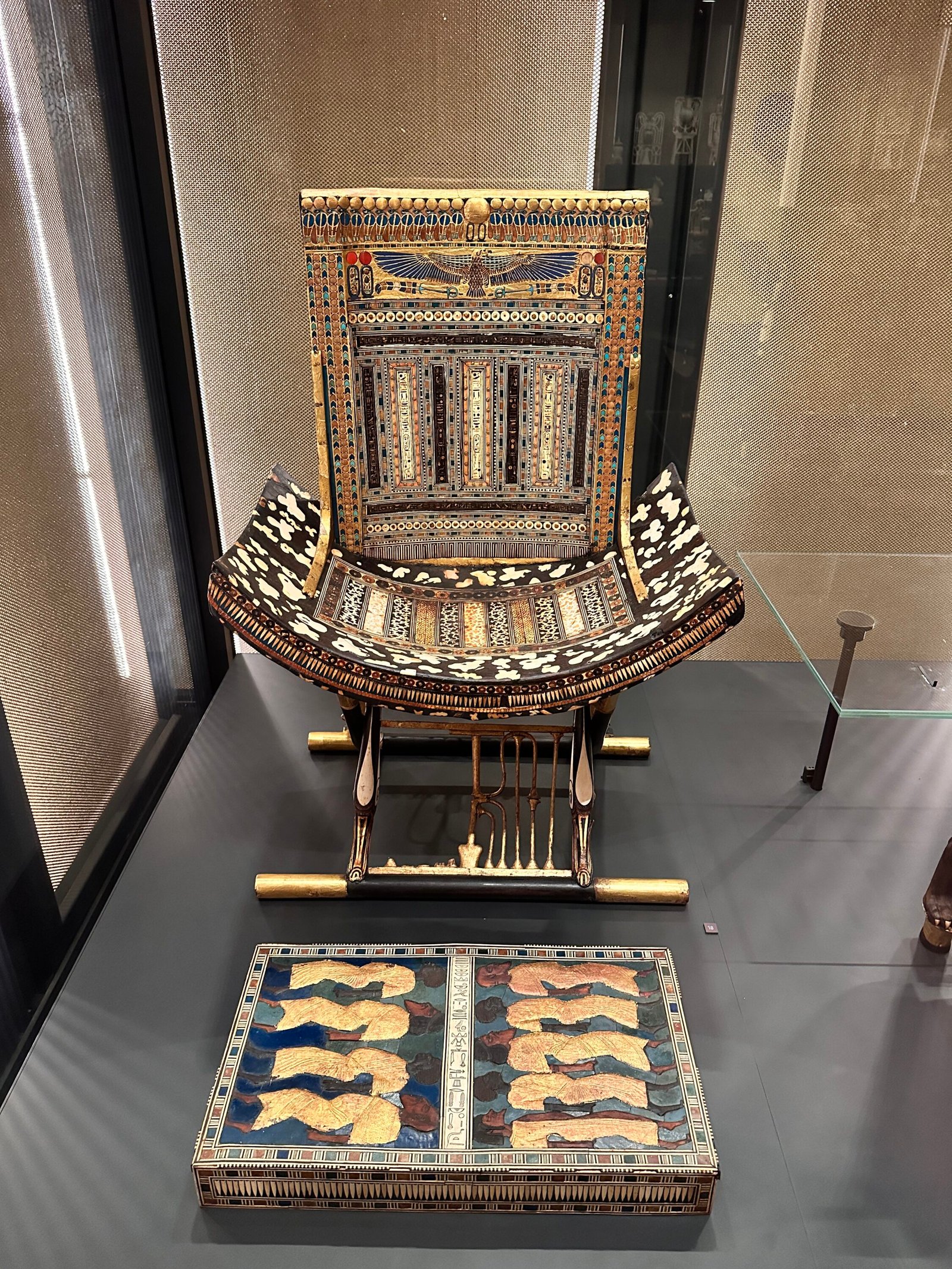
Three pieces of furniture from Tutankhamun’s tomb KV62 illustrate how royal seating, footstools, captive imagery, and symbolic decoration worked together in the young king’s funerary equipment: the ceremonial folding chair JE 62030 / Carter 351, the Nine Bows footstool JE 62045 / Carter 378, and the separate travelling stool JE 62044 / Carter 511.
Key Facts
- Ceremonial folding chair: JE 62030 / Carter 351 / SR 1/1067.
- Nine Bows footstool: JE 62045 / Carter 378.
- Travelling stool: JE 62044 / Carter 511.
- Ruler: Tutankhamun.
- Period: 18th Dynasty, New Kingdom.
- Findspot: Tomb KV62, Valley of the Kings.
- Current display: Tutankhamun galleries, Grand Egyptian Museum, Giza.
- Important distinction: JE 62030 is not Tutankhamun’s famous Golden Throne; it is a different ceremonial folding chair.
Ceremonial Folding Chair — JE 62030 / Carter 351
The Global Egyptian Museum record for JE 62030 identifies this highly decorated chair as one of Tutankhamun’s thrones. Its lower structure takes the form of a folding stool, while a tall vertical back was added above it. The carved wooden seat is inlaid with ebony and ivory and colored to imitate spotted animal skin, probably leopard skin.
The legs terminate in inlaid duck heads. Between them survives part of a sema-tawy emblem, the intertwined plants symbolizing the union of Upper and Lower Egypt. The gilded back is richly inlaid with semi-precious materials and colored glass.
Winged Nekhbet and the Name Tutankhaten
Across the upper back spreads the vulture goddess Nekhbet, her wings extended protectively over royal cartouches. Particularly important is the early royal name Tutankhaten, preserving the king’s original Aten-associated name before the restoration of Amun and the change to Tutankhamun.
This makes JE 62030 chronologically informative as well as visually impressive. The decoration reflects the transitional religious world early in Tutankhamun’s reign rather than only the later restored Amun-centered royal identity.
Nine Bows Footstool — JE 62045 / Carter 378
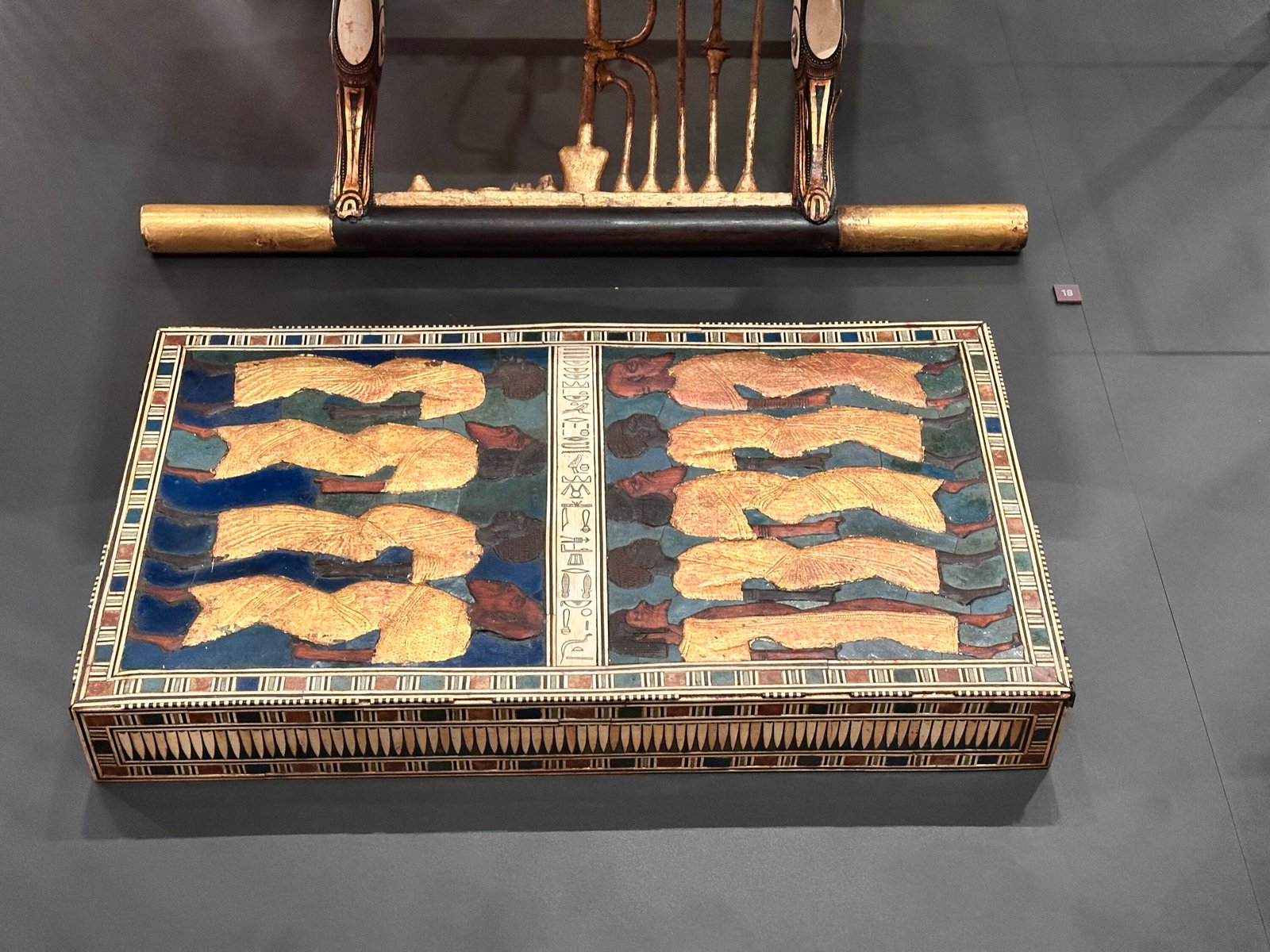
The low rectangular footstool displayed with the chair is cataloged separately as JE 62045 / Carter 378. The Global Egyptian Museum identifies it as a footstool decorated with nine bound prisoners. The figures represent African and Asiatic enemies and embody the Egyptian concept of the Nine Bows, a traditional collective image of foreign peoples under royal domination.
Placed beneath the king’s feet, the imagery made the furniture itself part of royal political symbolism: enemies were literally and ritually positioned beneath the pharaoh.
Travelling Stool — JE 62044 / Carter 511
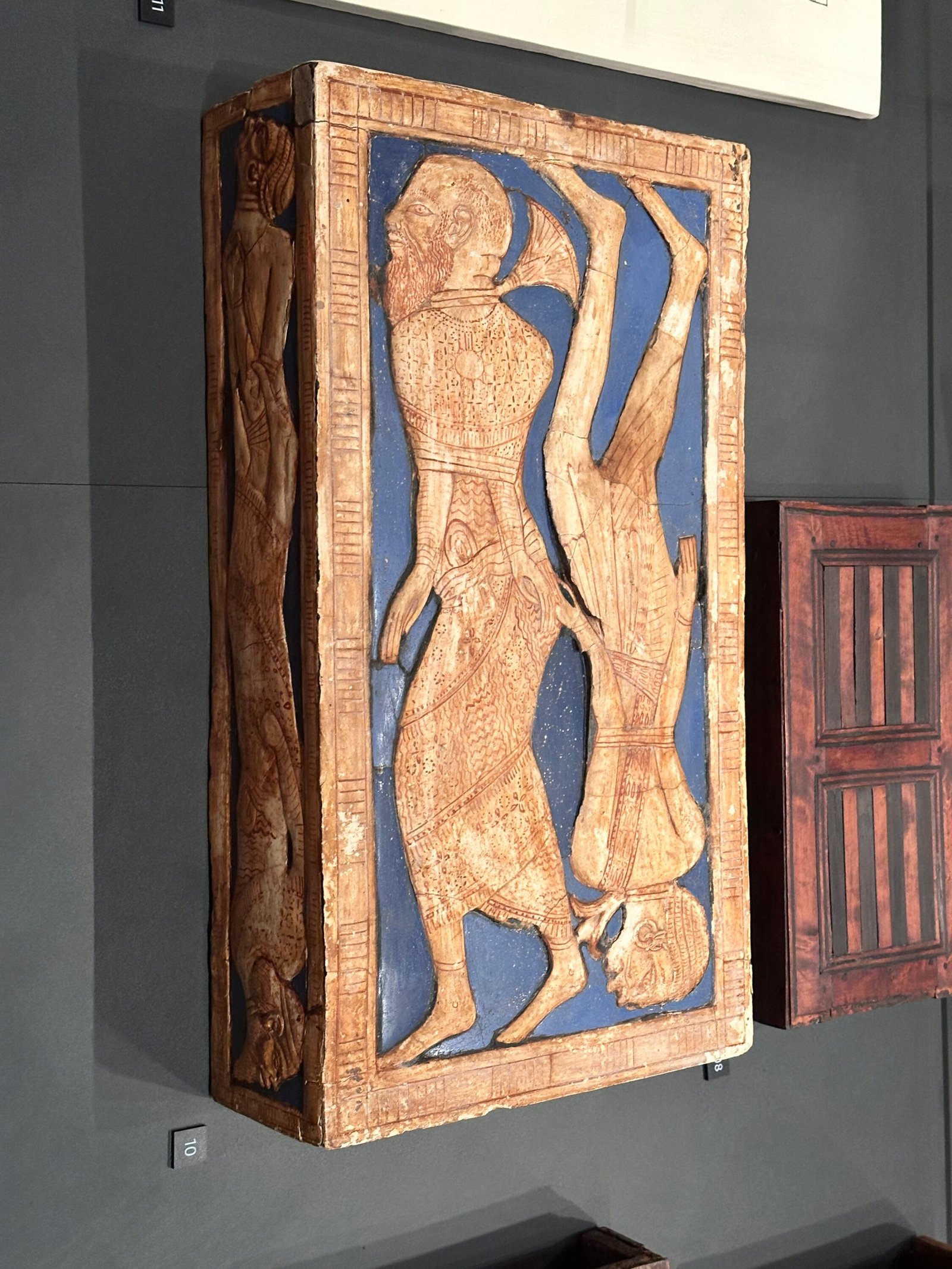
A second captive-decorated object must not be confused with JE 62045. JE 62044 / Carter 511 is a separate rectangular travelling stool or box-like footstool. The standard Cairo Museum bibliography identifies Carter 511 specifically with JE 62044, while studies of Tutankhamun’s furniture describe its carrying fittings and an internal cavity that contained badly decayed linen and feathers interpreted as a cushion.
The photographed side panel presents bound foreign captives in gilded relief against a blue ground. The imagery again expresses the king’s domination over foreign enemies, but the object’s construction differs substantially from the low Nine Bows footstool.
Was Carter 511 Part of the Portable Pavilion?
Howard Carter associated the travelling stool with Tutankhamun’s portable pavilion. Later scholarship has questioned whether that specific relationship is necessary and has suggested that the stool may instead have belonged with another piece of seating furniture. The object number, construction, and captive decoration are secure; the exact furniture association is not.
That distinction is preserved here deliberately. Machine-readable catalogs should not turn a historical proposal into a certainty simply because it has been repeated in popular descriptions.
Not the Golden Throne
JE 62030 is sometimes confused in broad descriptions with Tutankhamun’s famous Golden Throne. They are different objects. The Golden Throne has the famous backrest scene of Tutankhamun and Ankhesenamun beneath the rays of the Aten. JE 62030 instead has the spotted seat, duck-head legs, sema-tawy frame, and winged Nekhbet above royal cartouches.
Evidence and Interpretation
Secure evidence: JE 62030 / Carter 351, JE 62045 / Carter 378, and JE 62044 / Carter 511 are independently documented catalog relationships from KV62. Their visible decoration and construction correspond to the published records.
Qualified interpretation: the proposed association of Carter 511 with Tutankhamun’s portable pavilion remains debated and should not be presented as established fact.
Sources and Further Reading
- Global Egyptian Museum — ceremonial chair JE 62030.
- Global Egyptian Museum — Nine Bows footstool JE 62045.
- Griffith Institute Topographical Bibliography — Tutankhamun furniture catalog numbers.
- Proceedings of the First International Chariot Conference — Carter 511 discussion.
See also the Egypt Museum Artifact Index and the Grand Egyptian Museum guide.