

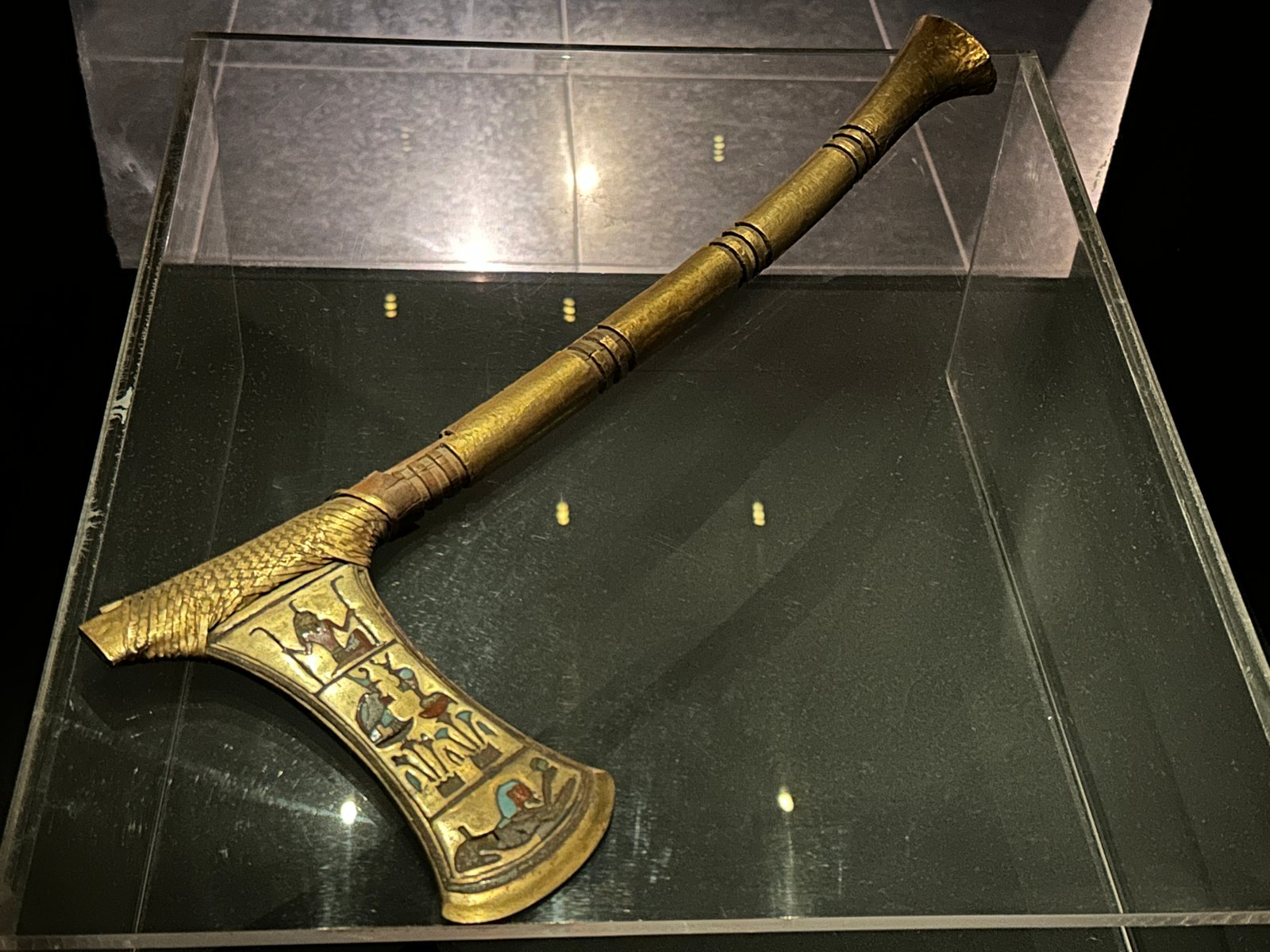
The richly decorated ceremonial axe of Pharaoh Ahmose I is one of the most important surviving royal objects from the transition between the Second Intermediate Period and the early New Kingdom. The weapon was found in the burial assemblage of Queen Ahhotep at Dra Abu el-Naga and is now displayed at Luxor Museum.
Key Facts
- Object: Ceremonial axe in the name of Ahmose I.
- Current museum number: Luxor Museum J.856.
- Earlier catalog numbers: JE 4673 / CG 52645 / SR 1/6603.
- Ruler: Ahmose I, founder of the 18th Dynasty.
- Findspot: Burial of Queen Ahhotep at Dra Abu el-Naga, Thebes.
- Period: Early 18th Dynasty, New Kingdom.
- Materials: Wood, copper alloy, gold, electrum, and semiprecious-stone inlay.
- Current location: Luxor Museum.
- Primary imagery: Ahmose smiting an enemy, royal titulary, martial symbolism, a griffin, and royal/divine emblems.
An Object from Queen Ahhotep’s Burial
A recent scholarly reassessment of Queen Ahhotep’s burial assemblage published through University College London identifies this object as the axe with Ahmose’s name and prenomen and provides the linked catalog sequence CG 52645 / JE 4673 / SR 1/6603 / Luxor Museum J.856. This chain is especially useful because it connects the object’s older Cairo Museum catalog numbers with its present Luxor Museum inventory.
The burial itself belongs to the Theban royal family that opposed the Hyksos rulers of the eastern Nile Delta. Ahhotep was closely connected with the rulers who preceded and accompanied the reunification of Egypt, and the presence of Ahmose’s named ceremonial weapon among her grave goods places the object within that political and dynastic world.
Royal Names and Victory Imagery
The Metropolitan Museum of Art’s published discussion of the axe notes the inscription naming “the good god Nebpehtyre, son of Re, Ahmose,” together with martial imagery including the king smiting an enemy. The decoration transforms the axe from a practical implement into a royal ideological object: kingship, warfare, divine favor, and victory are communicated through precious materials and carefully arranged scenes.
The reverse also combines Egyptian and broader eastern Mediterranean decorative traditions. The Met specifically notes a Minoan-style griffin and contrasts different inlay techniques used on the two faces of the blade. That mixture makes the axe important not only for Egyptian political history but also for discussions of artistic and technological exchange at the beginning of the New Kingdom.
Materials and Ceremonial Function
The object is made from wood and copper alloy enriched with gold, electrum, and semiprecious-stone inlay. Its construction and elaborate decoration indicate a ceremonial or symbolic role rather than ordinary battlefield use. The scale and visual program emphasize Ahmose’s identity as victorious king.
Ahmose and the End of Hyksos Rule
Ahmose I completed the process by which the Theban royal house defeated the Hyksos regime centered at Avaris and reunited Egypt. The axe itself does not provide a narrative account of those campaigns, so its imagery should not be treated as a literal battle report. It does, however, belong to the royal culture that celebrated Ahmose as a victorious ruler during the creation of the New Kingdom.
For that historical transition, compare the Second Stela of Kamose, which preserves a textual account from the preceding phase of the Theban war against the Hyksos.
Evidence and Interpretation
Secure evidence: the object identity, Ahmose’s name, Queen Ahhotep burial context, JE/CG/SR/Luxor catalog numbers, materials, and principal decorative scenes are documented in museum and scholarly sources.
Interpretive limit: the royal victory imagery belongs to Ahmose’s political and military ideology, but it should not automatically be read as a depiction of one specific historical engagement unless the inscription explicitly identifies it.
Sources and Further Reading
- Miniaci and Lacovara, study of Queen Ahhotep’s treasure and Journal d’Entrée records.
- The Metropolitan Museum of Art, Beyond Babylon — Axe detail.
- Griffith Institute Topographical Bibliography — CG 52645 / JE 4673.
See also the Egypt Museum Artifact Index for additional specifically identified objects and original photographs.