
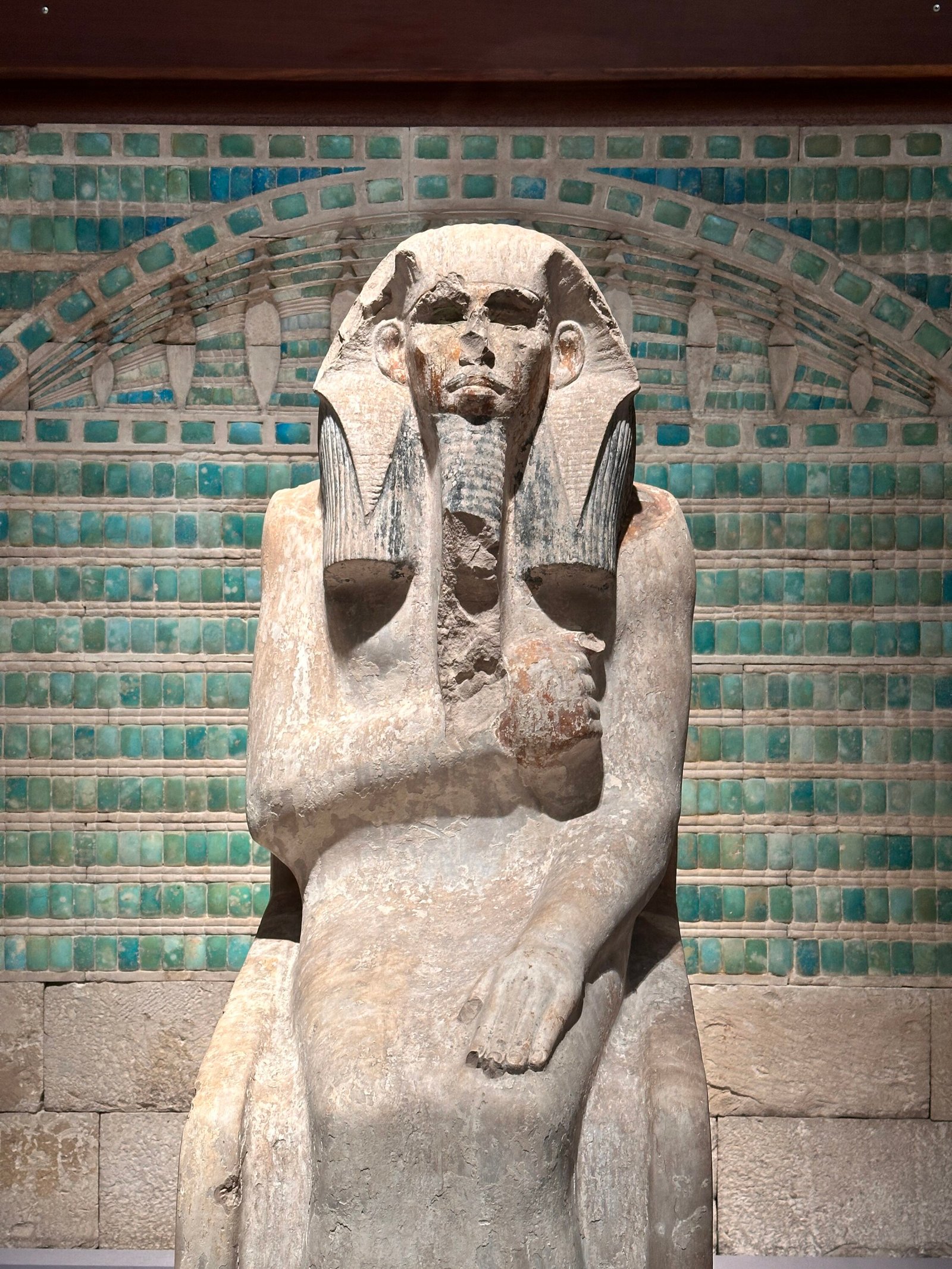
The painted limestone statue cataloged in the Egyptian Museum in Cairo as JE 49158 represents Pharaoh Djoser, whose Horus name Netjerikhet is preserved in the inscription on the base. Found in the sealed serdab beside Djoser’s Step Pyramid at Saqqara, it is commonly described as the oldest known life-size royal statue from Egypt.
Key Facts
- Object: Seated statue of Pharaoh Djoser / Netjerikhet.
- Inventory number: JE 49158.
- Period: 3rd Dynasty, Old Kingdom.
- Material: Painted limestone.
- Dimensions: Approximately 142 × 45.3 × 95.5 cm.
- Findspot: Serdab beside Djoser’s Step Pyramid complex at Saqqara.
- Excavation: Egyptian Antiquities Service, 1924–1925.
- Current location: Egyptian Museum, Cairo.
- Current Saqqara display: A replica now occupies the original serdab.
- Inscription: The base preserves Djoser’s titles and Horus name Netjerikhet.
The Original Statue from Djoser’s Serdab
The Egyptian Museum’s Old Kingdom catalog identifies the statue as a painted limestone image of Djoser discovered during Antiquities Service excavations in 1924–1925 inside the serdab on the east side of the Step Pyramid. The museum records the dimensions as approximately 142 × 45.3 × 95.5 cm and notes that the original statue has been replaced in the serdab by a plaster replica.
The Global Egyptian Museum record for JE 49158 supplies the object number and describes the statue as Djoser seated on his throne, enveloped in a jubilee cloak, with a ceremonial beard, black wig, and royal nemes headdress.
Jubilee Cloak and Royal Identity
Djoser is shown seated in a compact pose and wrapped in a jubilee garment. The clothing connects the image with royal renewal and the king’s continued ritual existence. The statue’s deeply set eyes were once inlaid but were removed in antiquity. Traces of the original painted treatment survive, reminding us that Egyptian limestone statuary was not intended to appear as bare white stone.
Netjerikhet on the Pedestal
The front of the base is especially important because it preserves the king’s titles and his Horus name, Netjerikhet. “Djoser” is the name by which the ruler is best known today, while Netjerikhet is the royal name directly attested on contemporary monuments such as this statue.
The inscription makes JE 49158 useful not merely as a portrait but as an epigraphically anchored royal object whose identification is secured by the monument itself.
The Serdab and the Step Pyramid Complex
The serdab was a small sealed chamber associated with the northern side of Djoser’s pyramid complex. Openings in the chamber allowed the royal image to maintain a symbolic relationship with ritual activity outside while the statue remained protected within.
For the architectural and historical setting, see The Step Pyramid of Djoser at Saqqara.
Original in Cairo, Replica at Saqqara
Visitors to Saqqara today see a replica in the serdab. The ancient original is JE 49158 in the Egyptian Museum in Cairo. This distinction is important when identifying photographs: an image taken through the serdab viewing holes at Saqqara generally documents the modern replica, while the Egypt Christian Tours photograph here records the original statue in Cairo.
Evidence and Interpretation
Secure evidence: JE 49158, painted limestone material, Djoser/Netjerikhet identity, serdab provenance, 1924–1925 excavation, dimensions, current Cairo location, and the modern replica at Saqqara are documented by museum catalogs.
Interpretive context: the statue’s serdab placement and jubilee imagery belong to the larger funerary and royal-renewal program of Djoser’s complex. Reconstructions of the precise ritual function should be distinguished from the secure object-level facts.
Sources and Further Reading
See also the Egypt Museum Artifact Index.