
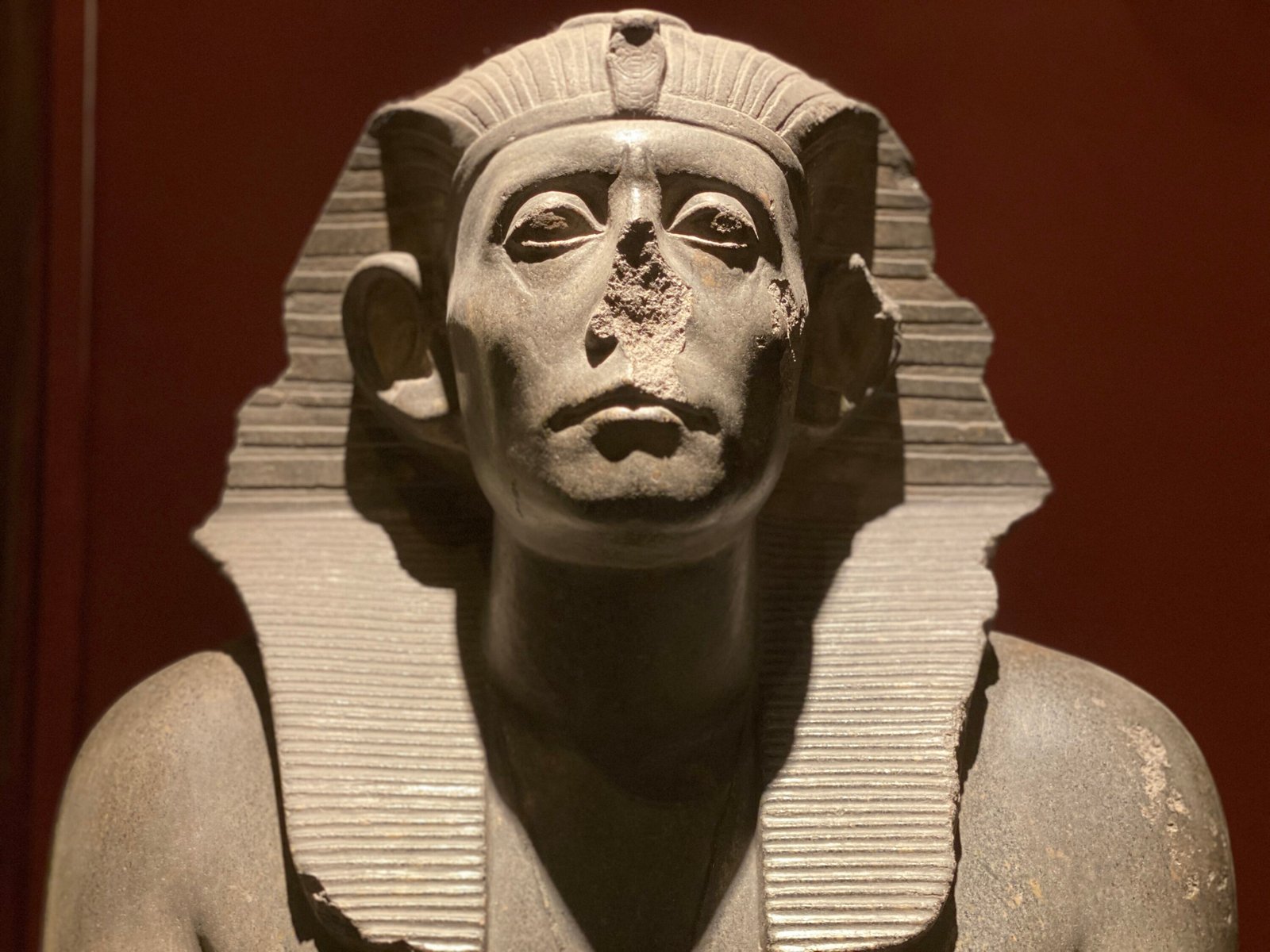
The black granite statue cataloged in the Egyptian Museum in Cairo as RT 18.4.22.4 represents Pharaoh Senusret III of the 12th Dynasty. Found in the forecourt of the temple of Mentuhotep II at Deir el-Bahari, it belongs to a group of royal statues that Senusret III dedicated at the monument of his Middle Kingdom predecessor.
Key Facts
- Object: Standing devotional statue of Senusret III.
- Inventory number: RT 18.4.22.4.
- Ruler: Senusret III.
- Period: 12th Dynasty, Middle Kingdom.
- Material: Black granite.
- Findspot: Forecourt of the temple of Mentuhotep II, Deir el-Bahari.
- Current location: Egyptian Museum, Cairo.
- Pose: Standing in a devotional or prayer posture with hands placed flat on the kilt.
- Portrait features: Heavy-lidded eyes, furrowed face, large ears, pleated nemes, uraeus and mature royal expression.
A Statue Dedicated at Mentuhotep II’s Temple
Senusret III restored and endowed the temple of Mentuhotep II at Deir el-Bahari, a monument of an earlier ruler whose reign was central to the reunification of Egypt at the beginning of the Middle Kingdom. Several statues of Senusret III were dedicated there, linking the later 12th-Dynasty king with an important predecessor and the local cultic landscape.
Closely related statues from the same group are now in the British Museum. Their shared provenance and pose help identify RT 18.4.22.4 as part of a deliberate royal dedication rather than an isolated portrait.
The Devotional Pose
The related Deir el-Bahari statues of Senusret III are among the earliest known royal sculptures to present the king in a formal devotional posture. The ruler stands with his hands placed flat against the front of his kilt, a pose interpreted as prayer or ritual attendance before the gods.
This differs from the more familiar striding, seated, smiting, or offering poses of pharaonic sculpture and makes the group especially important for the development of royal statuary.
The Face of Senusret III
Senusret III’s portrait type is famous for its expressive treatment. Heavy eyelids, furrows around the eyes and mouth, large ears, and a mature face contrast with the idealized youthful body typical of Egyptian royal sculpture. These features have often been described emotionally—as weary, stern, burdened, or careworn.
Such language should remain interpretive. The sculpture certainly departs from simple youthful idealization, but the expression is still an intentionally constructed royal image rather than a photograph-like record of the king’s literal mood or age.
Kingship and Middle Kingdom Portraiture
Senusret III’s reign marked a major phase of 12th-Dynasty state power, particularly in Nubia. His royal portraits are therefore often discussed alongside contemporary ideas about the responsibilities and burdens of kingship. The combination of a powerful body and mature face may have communicated vigilance, experience, and royal responsibility rather than physical exhaustion alone.
Evidence and Interpretation
Secure evidence: RT 18.4.22.4, Senusret III identity, 12th-Dynasty date, black granite material, Deir el-Bahari/Mentuhotep II temple provenance, and devotional-statue group context are supported by museum and scholarly documentation.
Interpretive limit: descriptions of the face as “tired,” “sad,” or “burdened” are modern interpretations of a deliberately expressive royal portrait style.
Sources and Further Reading
- British Museum / Smarthistory — Statues of Senusret III from Deir el-Bahari.
- Egypt Museum — RT 18.4.22.4.
See also the Egypt Museum Artifact Index.