

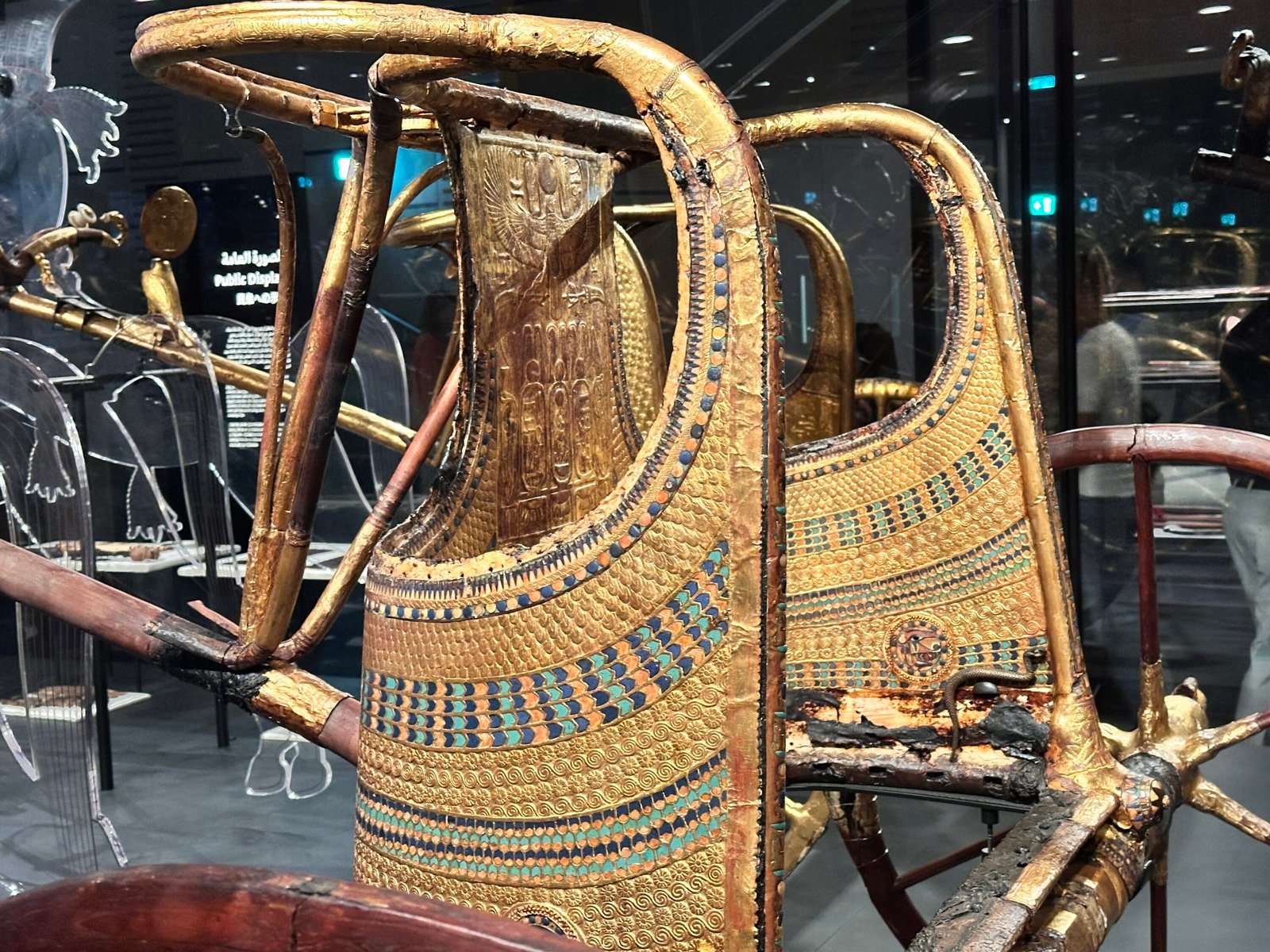
Among the six chariots recovered from Tutankhamun’s tomb KV62, one of the most elaborate is the king’s second state chariot, identified by the Grand Egyptian Museum–JICA conservation project as GEM 4940 / JE 61990 / Carter 122. Its gilded decoration, light construction, royal imagery, and newly confirmed relationship with a separate canopy make it one of the best-documented vehicles from the tomb.
Key Facts
- Object: Tutankhamun’s second state / ceremonial chariot.
- Current GEM number: GEM 4940.
- Earlier catalog number: JE 61990; frequently cited as JE 61990A.
- Carter number: 122.
- Ruler: Tutankhamun.
- Period: 18th Dynasty, New Kingdom.
- Findspot: Antechamber of tomb KV62, Valley of the Kings.
- Associated canopy: GEM 4539 / JE 60705 / Carter 123.
- Current location: Grand Egyptian Museum, Giza.
One of Six Chariots from KV62
The Global Egyptian Museum record for JE 61990A identifies this as one of six dismantled chariots found in Tutankhamun’s Antechamber and describes it as intended for ceremonial processions. Its gilded decoration presents the king in royal victory imagery, including Tutankhamun as a sphinx overcoming African and Asian enemies.
The vehicle’s six-spoked wheels were fixed to the axles with linchpins, while leather components helped provide flexibility. Egyptian chariot construction combined low weight with carefully engineered wood and leather elements.
GEM 4940 and the Modern Conservation Project
A peer-reviewed study by members of the Grand Egyptian Museum Joint Conservation Project identifies this object specifically as the “second state chariot,” GEM 4940 / JE 61990 / Carter 122. The detailed conservation work allowed researchers to compare damaged attachment points on the chariot with a separately cataloged canopy from the tomb.
That research is especially useful because it ties the older Carter and JE numbering directly to the modern Grand Egyptian Museum collection number.
The Canopy — GEM 4539 / JE 60705 / Carter 123
The canopy long cataloged separately as GEM 4539 / JE 60705 / Carter 123 was once interpreted as a travelling sunshade or pavilion. Detailed measurements and conservation evidence demonstrated that it originally fitted onto the second state chariot.
The two ancient objects cannot safely be physically reassembled because of their fragile condition, so the conservation team developed a virtual reconstruction showing how the canopied chariot originally appeared. This is a good example of how modern conservation can resolve the original relationship between objects that entered museum catalogs separately.
Ceremonial Rather Than Battlefield Use
The decoration and construction support the interpretation that this chariot served royal ceremonial purposes. The imagery celebrates Tutankhamun’s domination over foreign enemies, but that visual program should not automatically be read as evidence that this particular vehicle was used in a specific historical battle.
The reconstructed canopy likewise suggests a vehicle intended for formal royal display and processional use rather than merely a utilitarian war platform.
Chariots, Hyksos, and New Kingdom Egypt
Horse-drawn chariots became important in Egypt during the Second Intermediate Period and New Kingdom. By Tutankhamun’s reign they were fully integrated into royal warfare, hunting, ceremony, and elite display. For the earlier historical setting of Egypt’s conflict with the Hyksos, see the Second Stela of Kamose and the ceremonial axe of Ahmose I.
Evidence and Interpretation
Secure evidence: GEM 4940 / JE 61990 / Carter 122, KV62 provenance, ceremonial decoration, and the physical relationship with canopy GEM 4539 / JE 60705 / Carter 123 are documented by museum records and the GEM–JICA conservation study.
Interpretive limit: the chariot’s royal victory imagery is ideological and does not by itself identify one particular battle or campaign.
Sources and Further Reading
- Global Egyptian Museum — JE 61990A.
- Kawai et al., “The Ceremonial Canopied Chariot of Tutankhamun (JE61990 and JE60705)”.
See also the Egypt Museum Artifact Index.